La Roche-Posay Cicaplast Balm B5+ Review: Can Oily Skin Use It?
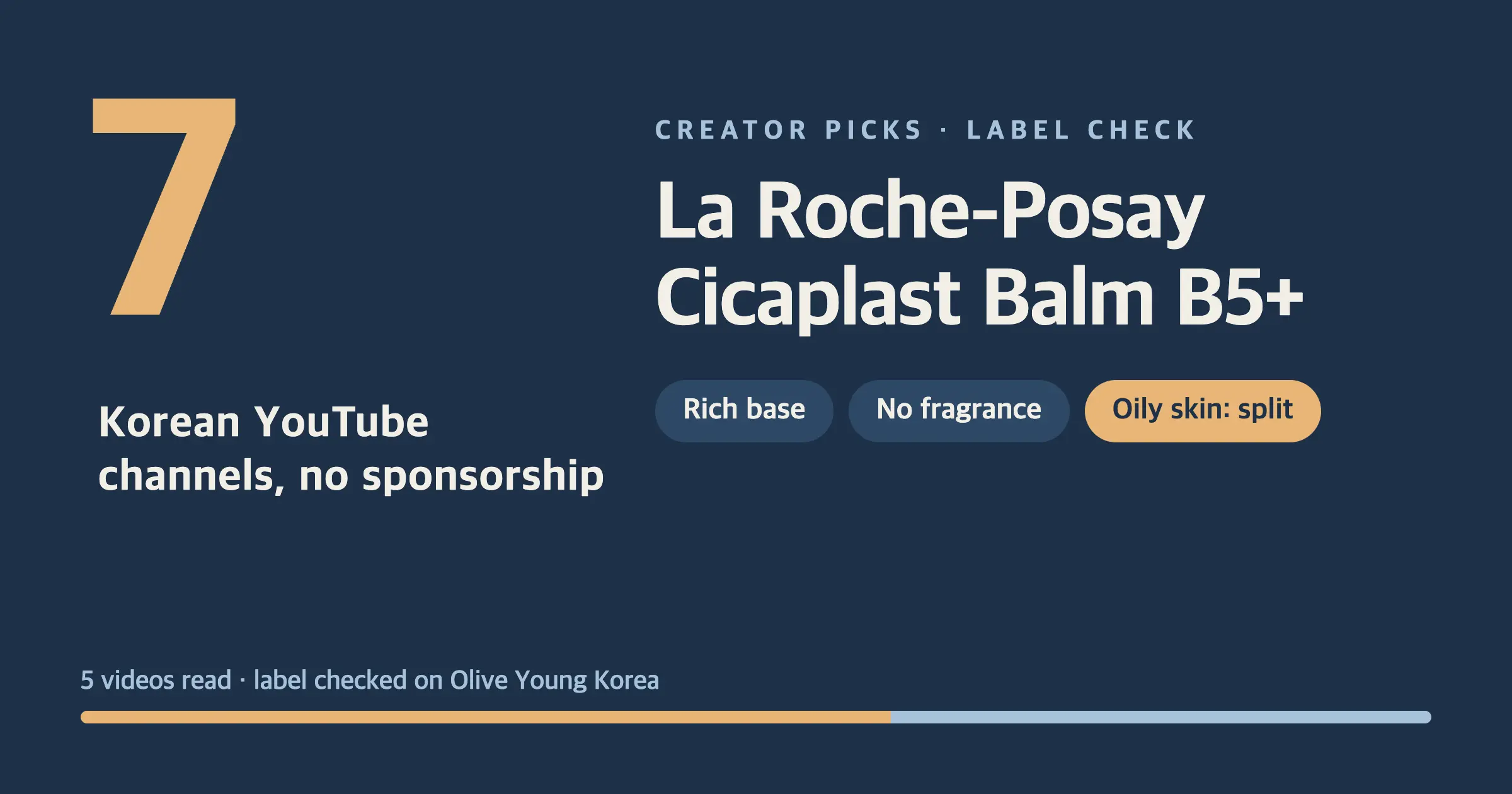
La Roche-Posay Cicaplast Balm B5+ came up in seven Korean YouTube channels in the last 30 days, all in videos not marked as paid promotion. It’s a French balm, yet it sells in Korea like a local bestseller. The creators don’t agree on it, though. One uses it as her main cream, and another says it’s too thick for oily skin. I read five of the videos and checked their claims against the Korean label.
Here’s how I got there. I looked at Korean YouTube videos from the last 30 days that weren’t marked as sponsored and counted which products came up across different channels. The search collected 266 videos, and 185 of them carried no sponsorship mark. La Roche-Posay was the most-mentioned brand in the set, with 11 channels counting its other creams. The balm alone appeared in seven.
What five creators said about the balm
| Creator | Where it comes up | Their take | Skin context |
|---|---|---|---|
| You need 윤이든 (Yoon-eden), 215K subscribers | Autumn barrier-care picks, 9:33 | Almost the only cream she uses lately | Recommends it for irritated, breakout-prone, dry skin |
| 화니 (Hwani), 173K | Autumn routine for oily-dehydrated skin, 9:09 | Uses it lately; one pea-sized dab as the last step | Oily-dehydrated |
| 조말랭 (Jomalraeng), 37K | Exfoliation routine, 8:02 | Good barrier cream, but not for oily skin | Video for oily, acne-prone skin |
| 스완 (Swan), 513K | Tier list of 35 creams, 19:52 | B grade; hard to recommend as an everyday cream | Mostly male viewers |
| 스칼렛 언니 (Scarlett), 131K | Test of 8 barrier creams, 7:55 | Greasiest of the eight; not one of her two picks | Combination, friction-prone |
None of the five videos is marked as paid promotion. Several descriptions list products the creator received for free, but the balm is not among them. Hwani and Jomalraeng both tag it as bought with their own money. Swan and Scarlett share shopping links that can earn a commission.
Yoon-eden and Hwani: a calming last step
Yoon-eden is the biggest fan of the five. She says she barely uses another cream these days, and she tells people with irritated or breakout-prone skin to try it. Her one worry was the thick texture, which she expected to cause pimples. She says it didn’t, and that her skin felt better the next morning.
Hwani gives practical advice rather than a rave. Her point is that too much cream causes breakouts, so she uses a pea-sized dab to seal in the toner and serum layers. She says any barrier cream works this way if you apply it thinly. One caution: her auto-captions garble the product name, and her description lists it as the Balm B5, so I treat her as a softer data point.
Jomalraeng, Swan and Scarlett: good, but heavy
Jomalraeng calls it a famous barrier cream and says it is good. Then she adds that oily skin finds it thick and slow to absorb, and she points those viewers to a lighter cream. That is a different verdict from Yoon-eden’s, who recommends it even to breakout-prone viewers.
Swan gives it a B. He likes the panthenol and the probiotic-style formula, but he says it spreads badly, feels slightly powdery and is very oily. He uses it now and then like a sleeping pack. He says it can work like a medicated ointment, but it does a weaker job as an everyday cream. He rates the sibling Multi-Repair Cream higher, an A, though he thinks both cost too much for Korea.
Scarlett is the most systematic. In her test of eight barrier creams, the balm felt thick when applied and was the greasiest on blotting paper and on skin. It also turned shiny and heavy under powder and a cushion foundation. She adds that a breakout doesn’t make a product bad, because very dry skin may need that much oil.
Where they agree and where they split
- Everyone calls it rich. Even the fans mention the heavy texture. Nobody describes it as light.
- The split is about oil. Yoon-eden has no breakouts from it. Jomalraeng, Swan and Scarlett steer oily skin elsewhere.
- Amount matters. Hwani’s pea-sized dab and Swan’s occasional sleeping-pack use both treat it as a small finishing step.
Comments under the videos are mixed in the same way. A few viewers said it works best when skin is truly flared up, not as a daily cream. A few dry-skinned viewers still reported small bumps now and then. Others asked whether the older B5 suits oily skin better than B5+, and I couldn’t confirm that.
What the Korean label shows
The ingredient list comes from the Olive Young Korea product information disclosure, matched to English names with the MFDS ingredient database. It has 33 ingredients, which is short for a K-beauty cream.
Why creators call it heavy
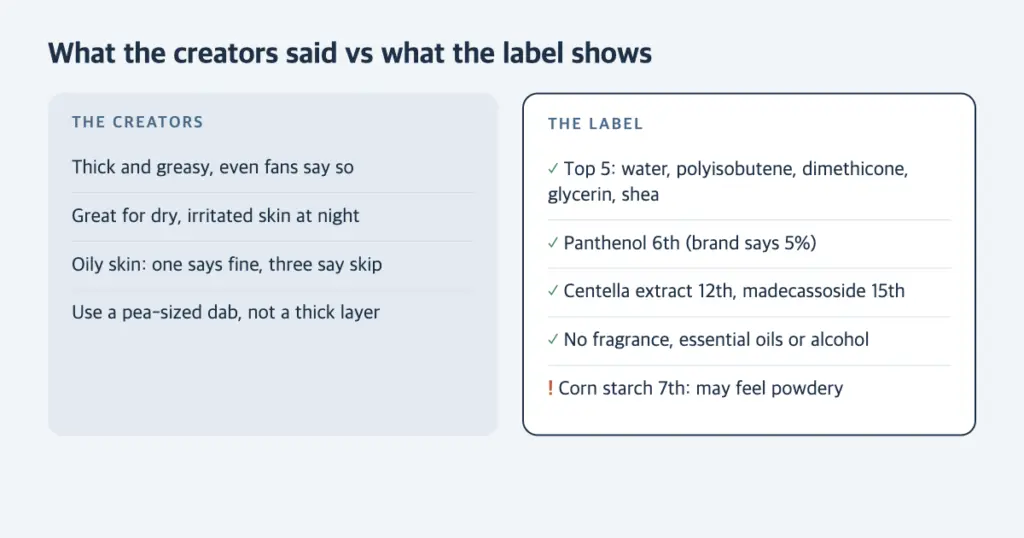
The first five ingredients are water, hydrogenated polyisobutene, dimethicone, glycerin and shea butter. Three of those five are emollient or occlusive types, so the label fits the greasy, thick feel the creators describe. Corn starch comes seventh and silica further down. Those are common picks for a dry, powdery finish, which may explain Swan’s comment. That link is my reading, and the label can’t prove it.
The panthenol claim
Panthenol sits sixth, right after the shea butter. The brand says the balm contains 5% panthenol, and the label order fits that claim, but the pack doesn’t print the amount. A small placebo-controlled study tested 5% dexpanthenol on 25 healthy volunteers. Skin hydration dropped less on the treated forearm after a harsh detergent challenge, though that was the only measurement to reach statistical significance. That study used a different product, so it supports the ingredient, not this balm.
Calming extras and what is missing
- Centella: Centella asiatica leaf extract is 12th and madecassoside is 15th, so the centella is a supporting part, not the headline.
- Minerals: zinc gluconate and manganese gluconate sit just after the yacon root juice (Polymnia sonchifolia).
- Microbiome-style items: Vitreoscilla ferment, Lactobacillus and alpha-glucan oligosaccharide fit the brand’s prebiotic story. The label doesn’t say which items make up its Tribioma complex.
- No fragrance, essential oils or alcohol appear on the list. Titanium dioxide comes last, as a white colorant.
It is not a functional cosmetic in Korea. The disclosure lists the MFDS functional review field as not applicable, and the pack calls it suitable for sensitive and all skin. If you have sensitive skin or react to shea or panthenol, patch test first and check with a dermatologist.
La Roche-Posay Cicaplast Balm price: Korea vs the US
| Where | What you get | Price | Rating |
|---|---|---|---|
| Olive Young Korea | 100 ml plus a free 3 ml | 41,000 won (about US$31) | 4.8 from 29,192 reviews |
| Olive Young Korea | 200 ml bundle with toner and serum minis | 54,000 won (about US$41), limited stock | Search listing |
| La Roche-Posay US | 100 ml | US$32.99 | 4.7 from about 4,000 reviews |
| Amazon US | US version, listed as Cicaplast Balm B5, 100 ml (3.38 fl oz), shipped and sold by Amazon | Check the current price on Amazon → | On Amazon |
I checked the prices on October 26, 2026, and converted with the ECB reference rate of 1,324.45 won per dollar from October 23. The brand’s US price is about 7% higher per 100 ml before shipping. Olive Young Global didn’t carry this balm when I searched. Amazon.com itself also sells the US version, listed as Cicaplast Balm B5, in the 100 ml size.
Who it is likely to suit
Here is what the creators say. Dry or irritated skin is where the fans are, usually at night and in a thin layer. Oily and breakout-prone skin got mixed reviews, from Yoon-eden’s thumbs-up to Scarlett’s warning.
Here is my reading of the label. It is a rich, fragrance-free balm built on silicone, polymer and shea. That suits dry, stressed skin in cold months, and it explains the oily-skin pushback. If the balm sounds too heavy, Aestura Atobarrier 365 Cream is another barrier cream that five creators picked, and I checked its label too. The Centellian24 Madeca Cream is a rich centella option. For background on barrier ingredients, see the ceramide skincare guide.
The short version
Korean creators agree that La Roche-Posay Cicaplast Balm B5+ is rich, and they split on whether oily skin can handle it. The label backs the heavy feel with silicone, polymer and shea, adds panthenol and a little centella, and has no fragrance.
Some links on Haamoni may be affiliate links. If you buy through one, I may earn a small commission at no extra cost to you. As an Amazon Associate I earn from qualifying purchases. This post is not medical advice.
Sources
- You need 윤이든 (Yoon-eden), autumn skin barrier care picks, uploaded 2026-10-10
- 화니 (Hwani), autumn routine for oily-dehydrated skin, uploaded 2026-10-04
- Amazon US, La Roche-Posay Cicaplast Balm B5 3.38 fl oz, shipped and sold by Amazon.com (checked 2026-10-30)
- 조말랭 (Jomalraeng), exfoliation routine for bumps and clogged pores, uploaded 2026-10-02
- 스완 (Swan), tier list of 35 creams, uploaded 2026-10-21
- 스칼렛 언니 (Scarlett), test of 8 barrier creams, uploaded 2026-10-05
- Olive Young Korea product page and product information disclosure (checked 2026-10-26)
- Olive Young Korea search listing for the 200 ml bundle (checked 2026-10-26)
- La Roche-Posay US, Cicaplast Balm B5+ product page (checked 2026-10-26)
- MFDS cosmetic ingredient database (data.go.kr)
- Biro et al., Efficacy of dexpanthenol in skin protection against irritation, Contact Dermatitis 2003 (PubMed)
- YouTube Data API v3, Korean beauty videos from the last 30 days (collected 2026-10-26)
- Frankfurter (ECB reference rate), USD/KRW on 2026-10-23