Ceramide Skincare: What Ceramides Do, What the Evidence Says, and How to Read the Label
Ceramide skincare is having a moment in Korea right now. In Naver’s shopping data, clicks on “ceramide” in the beauty category jumped sharply this fall. I covered that in this week’s K-beauty trends. So I wanted to answer the obvious next questions. What are ceramides, does the science back them up, and how do you spot them on a Korean ingredient list?
For this post, I used ingredient and regulation data from Korea’s Ministry of Food and Drug Safety (MFDS). I also read a handful of clinical papers on PubMed. I’ll be clear about where the evidence is strong and where it is thin.
What ceramides are
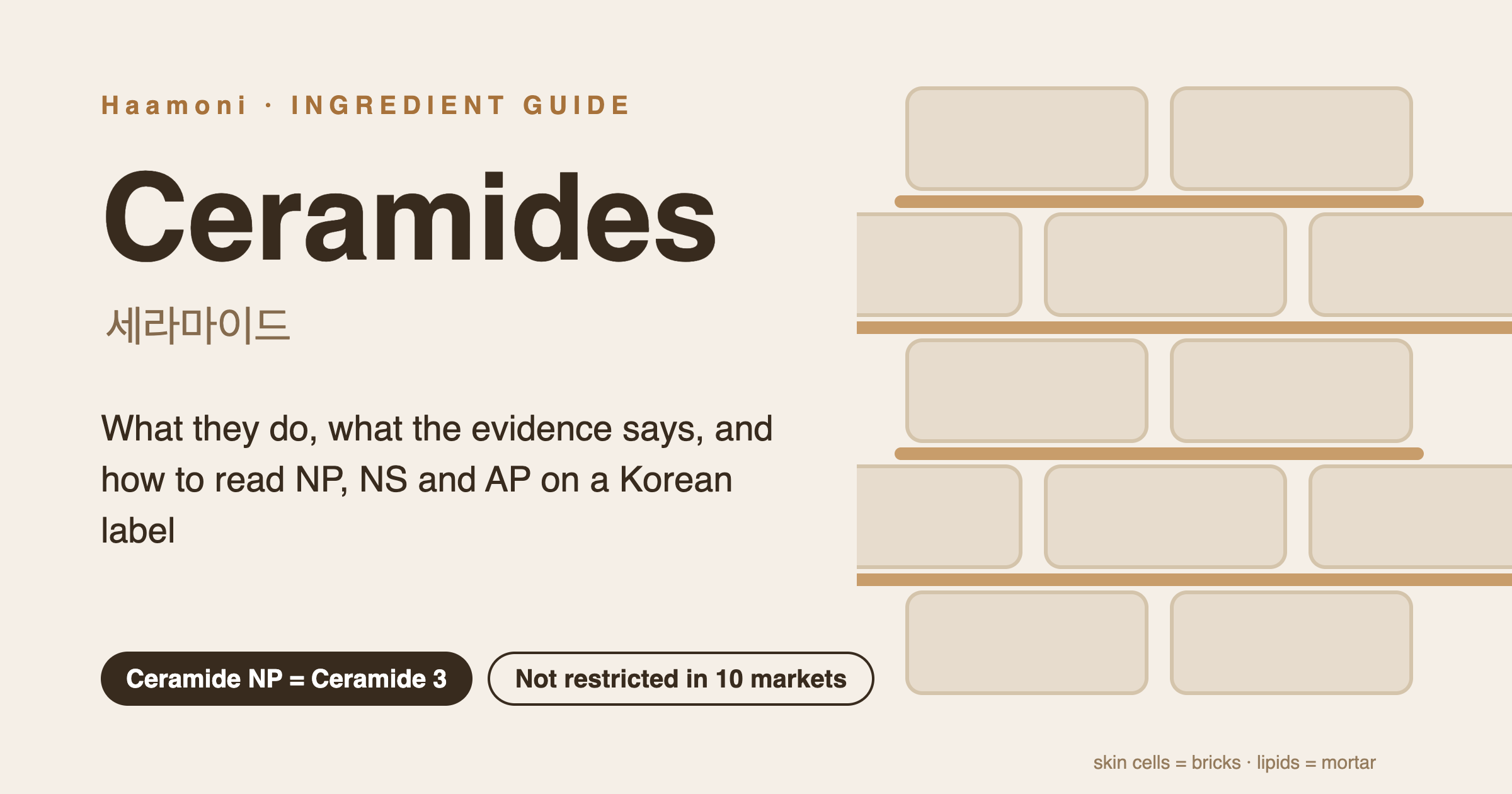
Ceramides are a family of fatty molecules (lipids) that your skin already makes. They sit in the outermost layer of skin, between the flattened cells, and help hold that layer together like mortar between bricks.
According to this review on stratum corneum lipids, that layer relies mostly on three lipid types: ceramides, cholesterol and free fatty acids. When ceramides run low, the barrier tends to leak more water, and skin gets drier and easier to irritate. That is the basic logic behind putting them in creams.
Why Korea is searching for ceramides now
The timing is mostly about weather, as far as I can tell. Korean autumn turns cold and dry fast, and shoppers move from sunscreen to barrier care. In Naver Shopping Insight, ceramide clicks over the last four full weeks were about 2.5 times the June to July average. Even so, it is still a smaller keyword than big categories like sunscreen or toner pads. So this is a growing niche, not the biggest thing in Korean beauty.
How to read ceramide names on a label
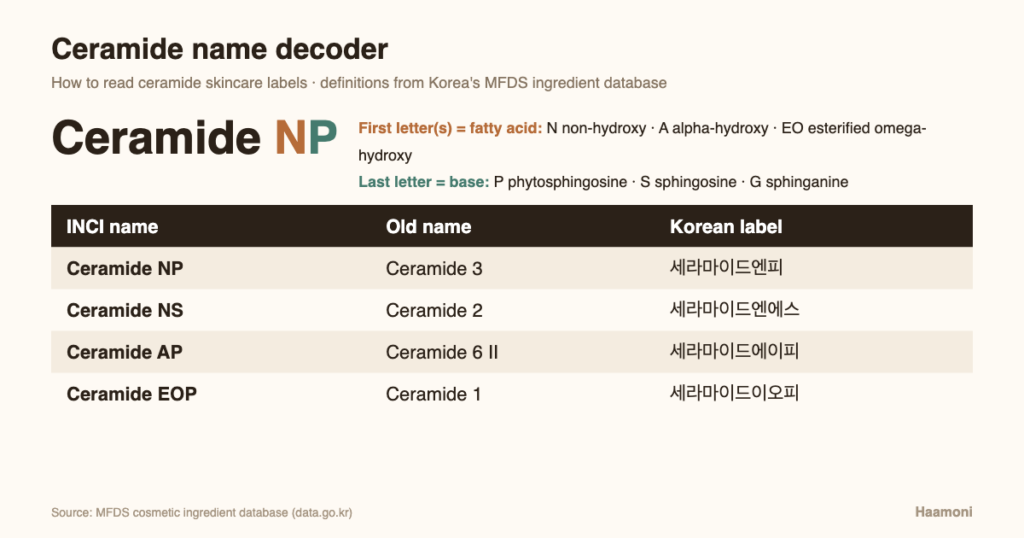
This is where it gets confusing, because the same ingredient can have two names. Older labels used numbers, like Ceramide 3. Newer international (INCI) names use letters instead. The MFDS ingredient database lists 17 ceramide-related entries, and its definitions explain what the letters mean.
| INCI name | Old name (per MFDS) | Korean label | Built from |
|---|---|---|---|
| Ceramide NP | Ceramide 3 | 세라마이드엔피 | Non-hydroxy fatty acid + phytosphingosine |
| Ceramide NS | Ceramide 2 | 세라마이드엔에스 | Non-hydroxy fatty acid + sphingosine |
| Ceramide AP | Ceramide 6 II | 세라마이드에이피 | Alpha-hydroxy fatty acid + phytosphingosine |
| Ceramide EOP | Ceramide 1 | 세라마이드이오피 | Esterified omega-hydroxy acid + phytosphingosine |
| Ceramide NG | Ceramide 2 (older, broader term) | 세라마이드엔지 | Non-hydroxy fatty acid + sphinganine |
Here is the simple version. The first letter or two describe the fatty acid part: N for non-hydroxy, A for alpha-hydroxy, EO for esterified omega-hydroxy. The last letter describes the base it is attached to: P for phytosphingosine, S for sphingosine, G for sphinganine. For example, the real ceramide in the Aestura cream I broke down was Ceramide NP.
Real ceramides vs. ceramide-like ingredients
Many Korean barrier creams also use lab-made lipids designed to act like ceramides. These are often called pseudo-ceramides. A common one is Hydroxypropyl Bispalmitamide MEA. In that same Aestura Atobarrier 365 Cream, two of these sat much higher on the ingredient list than the real Ceramide NP. So if a product says “ceramide” on the front, the back label tells you which kind you are actually getting.
What the evidence says about ceramide skincare
The research is encouraging, but mostly small, and much of it focuses on people with eczema-prone skin. Here are the three papers I found most useful.
- A 2021 review in the Journal of Dermatology looked at controlled studies and picked 12 for close analysis. It concluded that ceramide-containing products can improve dry skin and barrier function in atopic dermatitis, but called for larger double-blind trials.
- A 2025 study in the British Journal of Dermatology had 58 adults with a history of eczema use two creams on opposite arms and legs for 28 days. The cream with skin-identical lipids, including Ceramide NP and AP, improved barrier measurements. The plain glycerin cream reduced dryness but did not improve the barrier.
- A 2026 randomized trial in 60 adults with moderate atopic dermatitis tested a Ceramide NP cream on top of standard treatment. Both groups improved, and the ceramide group did a bit better on paper. However, the difference between groups was not statistically significant.
Put together, my read is this. Ceramides look genuinely useful as part of a well-built moisturizer, especially alongside cholesterol and fatty acids. But they are not magic. A single ceramide in a small amount probably won’t transform your skin on its own.
Ceramides in Korea vs. other countries
I checked both the MFDS list of restricted ingredients and its ingredient regulation list. These cover Korea, the EU, the US, Japan, China, ASEAN, Taiwan, Canada, Brazil and Argentina. None of the ceramide entries appeared as banned or limited in any of them.
In other words, unlike retinol or some preservatives, ceramides don’t come with country-specific caps. That makes them one of the easier ingredients to buy across borders.
Who ceramides suit, and who should be careful
- Dry skin and cold, dry weather are the classic fit.
- Easily irritated skin may benefit from barrier support, but the rest of the formula matters too, such as fragrance or essential oils.
- Oily skin can still use ceramides. Look for lighter lotions or gel creams rather than rich balms.
- If you have eczema or another skin condition, talk to a dermatologist. In the studies above, ceramide creams were used alongside treatment, not instead of it.
Where you’ll find them in Korean products
In Korean stores, ceramides show up most in barrier creams and lotions, and in lines marketed for very dry or sensitive skin. You will also see them in toners and ampoules, usually in smaller amounts. My tip: check where Ceramide NP sits on the list. Then see whether cholesterol and fatty acids, like stearic or palmitic acid, are there too.
The short version
Ceramides are lipids your skin already makes, and creams that add them, especially with cholesterol and fatty acids, have reasonable but still small-scale evidence for helping dry, barrier-damaged skin. On Korean labels, look for Ceramide NP (old name Ceramide 3), and know that many barrier creams also use ceramide-like substitutes.
Some links on Haamoni may be affiliate links. If you buy through one, I may earn a small commission at no extra cost to you. This post is not medical advice.
Sources
- MFDS cosmetic ingredient database (data.go.kr)
- MFDS restricted cosmetic ingredients by country (data.go.kr)
- MFDS cosmetic ingredient regulation list (data.go.kr)
- Stratum corneum lipids review, Curr Probl Dermatol 2016 (PubMed)
- Kono et al., ceramide formulations qualitative review, J Dermatol 2021 (PubMed)
- Andrew et al., physiological lipids and barrier function, Br J Dermatol 2025 (PubMed)
- Gu et al., Ceramide NP moisturizer randomized trial, Skin Pharmacol Physiol 2026 (PubMed)
- Naver DataLab Shopping Insight, beauty category keyword clicks