Medipeel Mooltox Serum Review: How Much Copper Peptide Is Really Inside?
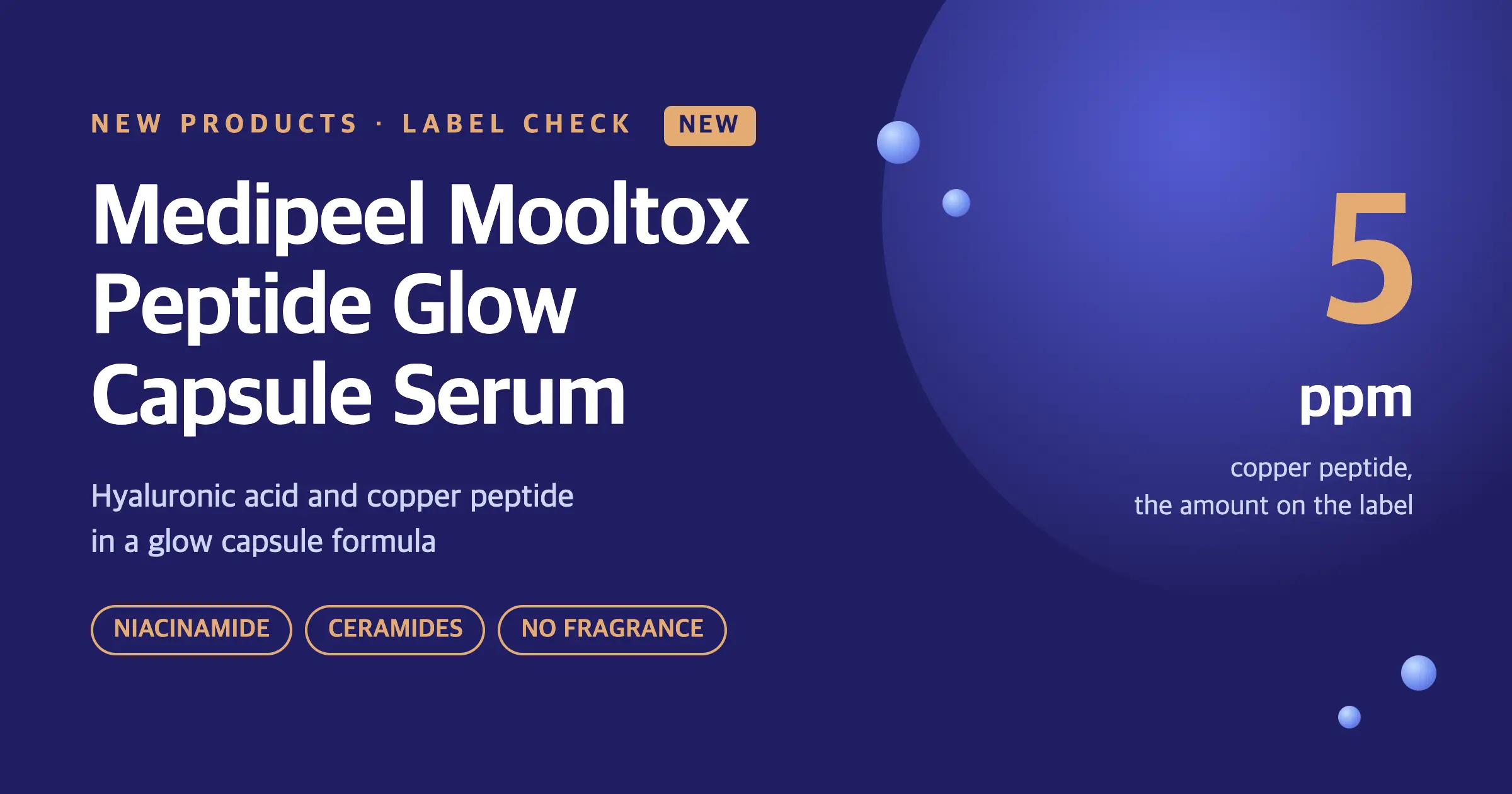
Medipeel Mooltox Serum is a new serum from the Korean brand Medipeel. The launch was announced on October 23, 2026, and the Korean beauty retailer Olive Young sells it in Korea and on its global site. The full name is 물톡스 펩타이드 글로우 캡슐 세럼 (mooltox peptide glow capsule serum), and 물 means “water”. It pairs hyaluronic acid with copper peptide in what the label calls a “glow capsule” formula. So I read the Korean ingredient list, all 76 names, and compared it with Medipeel’s existing hyaluronic acid ampoule from the same Mooltox line.
The serum at a glance
| Details | |
|---|---|
| Product | Mooltox Peptide Glow Capsule Serum, 30 ml |
| Launch | Announced October 23, 2026, sold at Olive Young |
| Pitched for | “All skin types” (per the Olive Young product information) |
| Made by / sold by | Kolmar Korea (manufacturer), Skin Idea Co. (responsible seller) |
| Functional cosmetic | Yes, reviewed or reported with MFDS (Korea’s Ministry of Food and Drug Safety), but the notice doesn’t say which function |
| Shelf life | 30 months unopened, 12 months after opening |
| Price in Korea | 24,900 won list, 16,830 won on sale (about $12.68) |
MFDS runs Korea’s functional-cosmetic system, which covers claims such as brightening or wrinkle care. The Olive Young notice says this serum went through it. However, I couldn’t find the entry in the MFDS data I can search, so I can’t tell you which claim it covers.
How Medipeel Mooltox Serum differs from the existing ampoule
Medipeel also sells the Hyaluronic Acid Layer Mooltox Ampoule (히알루론산 레이어 물톡스 앰플). Olive Young Global lists it as the Hyaluron Layer Mooltox Ampoule. I read its label from the Olive Young Korea 30 ml + 30 ml double-set listing. The two share a line name and several ingredients. The serum lists copper peptide and more ceramides, and it prints no hyaluronic acid amounts.
| New Mooltox serum | Existing HA Layer ampoule | Torriden Dive-In serum | |
|---|---|---|---|
| Copper Tripeptide-1 | 5 ppm, or parts per million (26th of 76) | Not listed | Not listed |
| Hyaluronic acid amount printed | None | 500.1 ppm sodium hyaluronate, 30 ppm hydrolyzed HA | 1,000 ppm hydrolyzed HA |
| Niacinamide | 8th | 7th | Not listed |
| Adenosine | 14th | Listed | Not listed |
| Ceramides | NP, AP, AS, NG, NS and one more name I couldn’t match | NP only | NP only |
| Fragrance or ethanol | None listed | None listed | None listed |
| Functional cosmetic (per Olive Young notice) | Yes | Yes | No |
The main difference is the peptide. The ampoule has none, and the serum lists one at a stated amount. On the other hand, the ampoule prints two hyaluronic acid amounts and the serum prints none. That means I can’t say which one has more hyaluronic acid. The label only lets you compare what the brand chose to print.
The copper peptide at 5 ppm
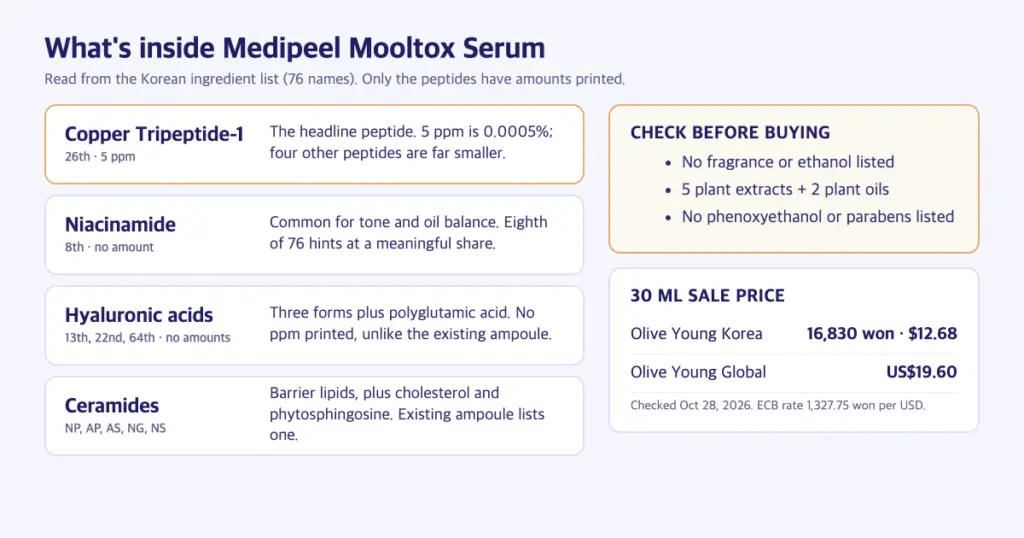
Copper Tripeptide-1, usually called copper peptide, is the star of the pitch. The label prints its amount as 5 ppm. One ppm is 0.0001%, so 5 ppm is 0.0005%. That is a small amount, though it is a stated one.
Four more peptides are listed with amounts in ppb, or parts per billion: Acetyl Hexapeptide-8 at 0.055, Tripeptide-1 at 0.01, Palmitoyl Pentapeptide-4 at 0.005 and Hexapeptide-9 at 0.005. Since 1 ppm equals 1,000 ppb, those four are trace amounts next to the copper peptide. My Medicube peptide cream post showed a similar pattern. Whether 5 ppm does anything you can see isn’t something a label can answer, so treat it as a small extra.
One detail is worth knowing. The label notes that the blue color of copper peptide can fade after long exposure to light, and that the product itself is fine. It also says to keep the bottle out of direct sunlight.
What else is in Medipeel Mooltox Serum
- Niacinamide (8th). No amount is printed. Position isn’t a measurement, but eighth of 76 suggests it’s among the more abundant ingredients.
- Three forms of hyaluronic acid. Sodium Hyaluronate (13th), Hydrolyzed Hyaluronic Acid (22nd) and Hyaluronic Acid (64th). Polyglutamic Acid (59th) adds another humectant, meaning a water-binding ingredient.
- Adenosine (14th), a familiar name in Korean skincare, with no amount printed.
- A ceramide mix. I matched Ceramide NP (38th), AP, AS, NG and NS. A sixth name, 세라마이드디오피, didn’t match the MFDS database. Cholesterol (49th) and phytosphingosine (48th) sit nearby, and stearic acid and oleic acid appear too.
- Soothing and softening extras. Panthenol (33rd), ectoin (32nd) and squalane (34th) all appear in the middle of the list.
Ceramides are the barrier lipids I covered in my ceramide skincare guide. Panthenol has its own write-up in my panthenol skincare post.
The base is mostly watery. Six humectants and solvents come right after water: propanediol, pentylene glycol, glycerin, dipropylene glycol, methylpropanediol and 1,2-hexanediol. Butylene glycol follows at 15th. That fits a light, gel-like serum. I matched the Korean names to INCI names (INCI is the international ingredient naming standard) with the MFDS ingredient database. Five names didn’t match: methylpropanediol, guaiazulene, enantia chlorantha bark extract, oleic acid and the sixth ceramide.
What to watch for on the label
- No fragrance, no ethanol, no essential oils. I read all 76 names and found none. Phenoxyethanol and parabens aren’t listed either.
- Plant extracts. Eclipta prostrata leaf, kelp (Laminaria japonica), hydrolyzed gardenia, enantia chlorantha bark and anemarrhena root are all listed. Rice bran oil and sunflower seed oil appear too. If you react to botanicals, patch test first.
- Preserving ingredients. Caprylhydroxamic acid, caprylyl glycol and ethylhexylglycerin are commonly used to help preserve formulas. If one of them has bothered your skin before, check for it.
- Capsule ingredients. Olive Young’s notice marks the capsule components with an asterisk. Gellan gum, agar and guaiazulene are among them. I couldn’t match guaiazulene in the MFDS database.
- Acids late in the list. Lactic acid (54th) and ascorbic acid (68th) sit in the last third of the 76 names.
Who it’s likely to suit
Based on the formula, this reads as a light hydrating serum for normal, dry or combination skin. The humectants and the ceramide and sterol mix point toward comfort rather than oil control. No fragrance or ethanol makes it easier to try than many serums, though the plant extracts could bother very reactive skin.
This is a reading of the ingredients, not a skin test. Texture and feel are personal, so check reviews from people with your skin type. Olive Young Global shows a 5.0 average from 150 reviews on the 30 ml listing, all from Korean customers, as of October 28, 2026. That’s a small, early sample. If you have sensitive skin or you’re pregnant, check with a dermatologist first.
Medipeel Mooltox Serum price: Korea vs Olive Young Global
| Where | Size | List price | Sale price |
|---|---|---|---|
| Olive Young Korea | 30 ml | 24,900 won (about $18.75) | 16,830 won (about $12.68) |
| Olive Young Korea, set | 30 ml + 10 ml, with cotton pads | 24,900 won (about $18.75) | 16,830 won (about $12.68) |
| Olive Young Global | 30 ml | US$29.00 | US$19.60 |
| Olive Young Global, set | 30 ml + 10 ml, with cotton pads | US$29.00 | US$19.60 |
I checked prices on October 28, 2026, and converted won at the ECB rate of 1,327.75 won per dollar from October 27. At those numbers, the Global sale price is about 55% higher than the Korean one. Both sites also list the 30 ml + 10 ml set at the same price as the bottle alone. That works out to about 561 won per ml for the bottle and 421 won per ml for the set in Korea. The Korean set page says it ships on a reservation basis from November 2. Businesskorea reports a launch promotion running November 1 to 22, so prices may change. Check again before you order.
Buying and storing it
- The won prices are for delivery within Korea. Olive Young Global ships overseas, with free shipping over US$60, so a single serum may not reach it.
- Olive Young Global’s page also showed a first-order coupon (30% off, up to US$7) on the day I checked.
- Look at the set listing if you want the extra 10 ml, since it costs the same right now. Check its ship date first.
- Store it away from sunlight, as the label asks.
Two similar serums to compare
Torriden Dive-In Low Molecular Hyaluronic Acid Serum is the plainer choice. Its label prints 1,000 ppm of hydrolyzed hyaluronic acid and has panthenol, ectoin and Ceramide NP, but no niacinamide, adenosine or peptides. It costs 16,500 won for 50 ml (about $12.43), or about 330 won per ml, on its current sale.
Medipeel’s own Hyaluronic Acid Layer Mooltox Ampoule (linked above) is the closer match. It keeps niacinamide and adenosine, prints two hyaluronic acid amounts, and has no copper peptide. If a stated hyaluronic acid amount matters to you, it gives you more to go on.
The short version
Medipeel’s new Mooltox Peptide Glow Capsule Serum pairs hyaluronic acid with copper peptide at a printed 5 ppm, plus niacinamide and a ceramide mix, with no fragrance or ethanol listed. It costs 16,830 won on sale in Korea, about 35% less than the Olive Young Global sale price.
Some links on Haamoni may be affiliate links. If you buy through one, I may earn a small commission at no extra cost to you. As an Amazon Associate I earn from qualifying purchases. This post is not medical advice.
Sources
- Businesskorea: Medipeel Mooltox serum launch at Olive Young (2026-10-23)
- Olive Young Korea product page and product information notice (checked 2026-10-28)
- Olive Young Korea 30 ml + 10 ml set (checked 2026-10-28)
- Olive Young Global product page (checked 2026-10-28)
- Olive Young Global set page (checked 2026-10-28)
- Olive Young Korea: Medipeel Hyaluronic Acid Layer Mooltox Ampoule, 30 ml + 30 ml double set (checked 2026-10-28)
- Olive Young Korea: Torriden Dive-In serum 50 ml (checked 2026-10-28)
- MFDS cosmetic ingredient database (data.go.kr)
- Frankfurter (ECB reference rate), USD/KRW on 2026-10-27