Daiso Fusiderm Capsule Cream Review: Brightening Actives for 5,000 Won?
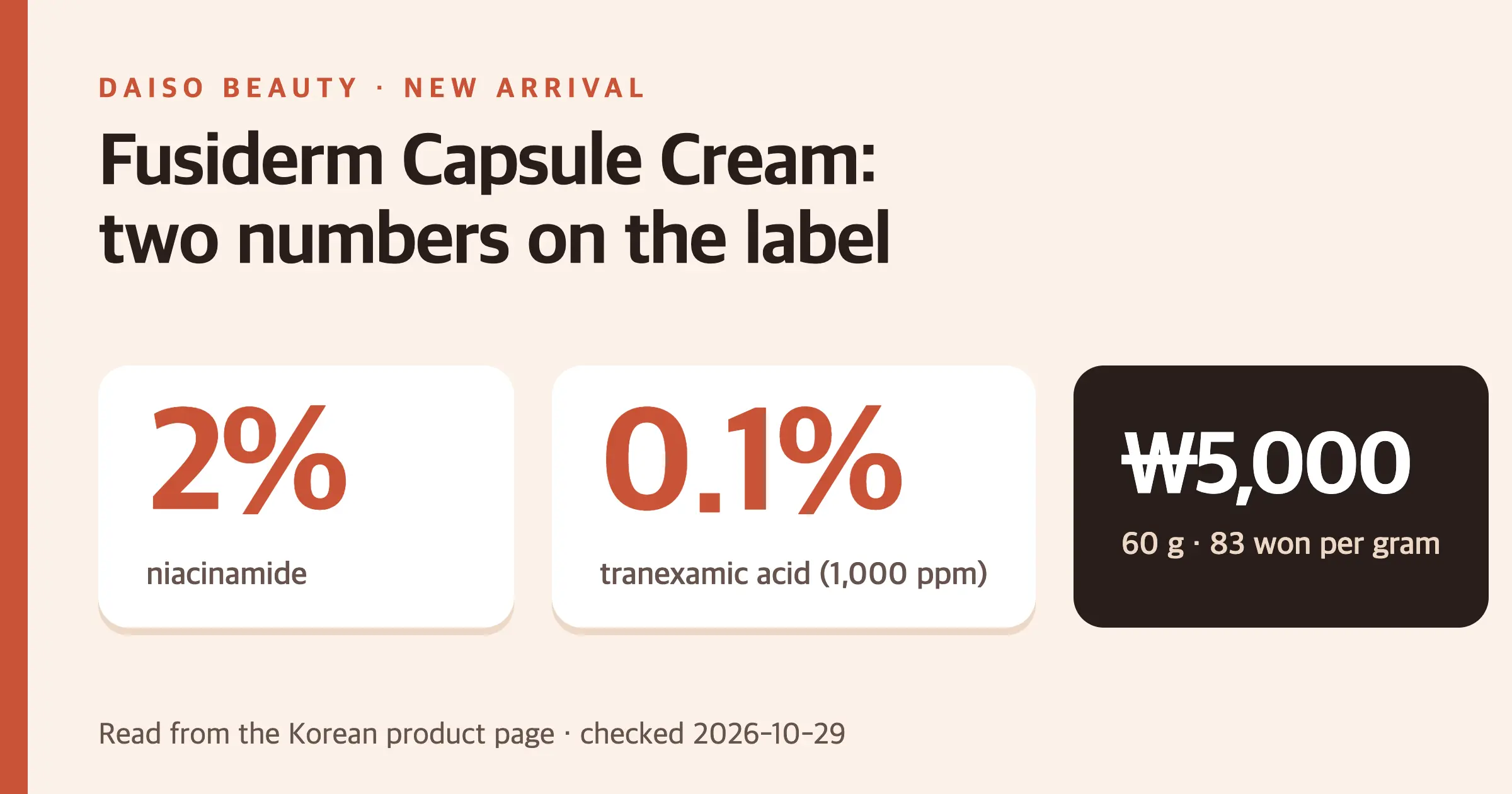
The Daiso Fusiderm capsule cream (Blemish Repair Capsule Cream, 후시덤 흔적 리페어 캡슐 크림) costs 5,000 won for 60 g. The product images print two numbers: niacinamide 2% and tranexamic acid (TXA) 1,000 ppm, which is 0.1%. No other amount is printed anywhere. So the real question is what a 2% brightening cream looks like when it sits next to 42 other ingredients.
The information table on the page has no column for amounts, and the ingredient list is a picture at the bottom of the page. I zoomed in and typed out all 44 names. Each one matches a standard name in the database of Korea’s Ministry of Food and Drug Safety (MFDS).
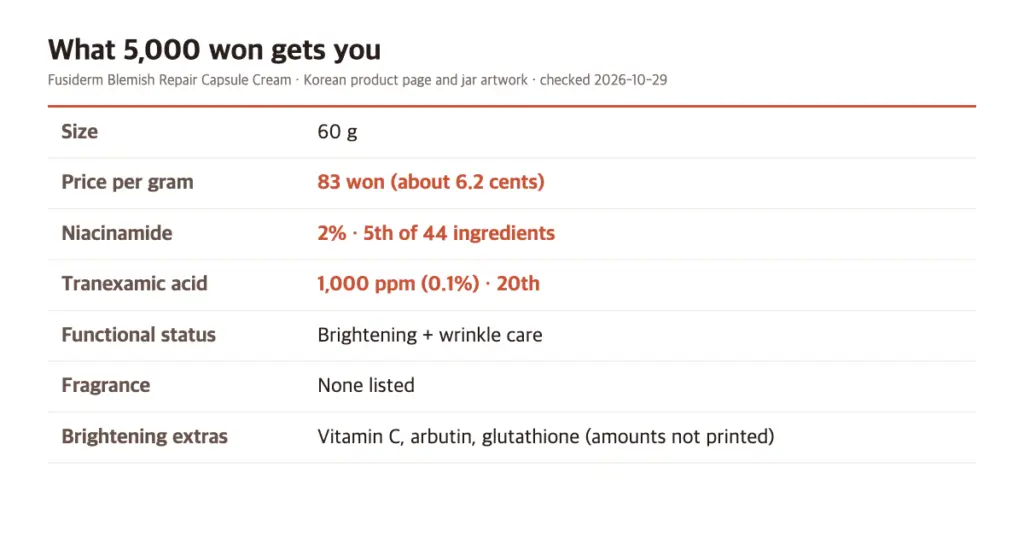
Daiso Fusiderm capsule cream at a glance
| Fusiderm Blemish Repair Capsule Cream (후시덤 흔적 리페어 캡슐 크림) | |
|---|---|
| Price | 5,000 won (about $3.73) |
| Size | 60 g |
| Price per gram | 83 won (about 6.2 cents) |
| Printed amounts | Niacinamide 2%, tranexamic acid 1,000 ppm (product images) |
| Functional cosmetic | Brightening and wrinkle care (both claims on the label) |
| Fragrance | None listed |
| Ingredients | 44, niacinamide in 5th place |
| Maker / seller | ES Cosmetic (maker), Dongwha Pharm (seller) |
| Shelf life | 36 months unopened, 12 months after opening |
This is a new arrival. Dongwha Pharm, the company behind the Fusiderm brand, announced the five-product Blemish Repair line for Daiso on October 14, 2026, according to the medical outlet Medigate News. Daiso lists the product as new. On October 29, 2026, its page showed 4.8 stars from 469 reviews.
What the 2% means in a 60 g jar
Niacinamide (나이아신아마이드) is vitamin B3. Korea’s functional cosmetics standards cover it as a brightening ingredient at 2 to 5%, so this product sits at the very bottom of that range. Medigate says the toner and cream mask in the same line also use 2%. Two other products in the line go much higher: a 10% ampoule and a 15% spot cream.
If the 2% were measured on the whole 60 g, that would be about 1.2 g of niacinamide in the jar. That is a modest amount, though it is at least a number you can see. The detail images group the 2% under the capsule, and no capsule-to-gel ratio is given. So treat 1.2 g as a rough guide, not a measurement.
The other number is tranexamic acid, or TXA. It appears 20th on the list, and 1,000 ppm means 0.1%. On the same whole-jar assumption that is roughly 60 mg. Both numbers come from the product images, which print them on the jar and again in a capsule diagram. I couldn’t find the TXA figure in Medigate’s report.
Reading the order after niacinamide
Korean labels list ingredients from most to least. Ingredients used at 1% or below can be listed in any order, according to Korea’s labeling rules. So the sequence only tells you so much.
Still, the early part of the list is easy to read. Water, glycerin, butylene glycol and propanediol come first, which suggests a water-based cream. Niacinamide follows in fifth place, then caprylic/capric triglyceride and ethylhexyl palmitate, two light oils.
Panthenol is 16th, with no amount printed. Betaine is 18th and allantoin is 22nd, two soothing and moisturizing helpers. I would treat them as supporting ingredients, not as the main event.
Fusidium coccineum ferment filtrate sits 19th, just before the TXA. Medigate’s report says the whole line contains it. The product page calls it a fermentation-derived ingredient and the brand’s own formula, but gives no amount or specific effect. So I can’t say what it adds.
The brightening names near the end
Arbutin is 29th. Glutathione is 36th. Ascorbic acid (vitamin C) is 37th. All three are well known in brightening skincare, and all three are listed after the TXA.
That order tells us less than it seems. As noted above, anything at or below 1% can be listed in any order. So the label can’t show whether these three sit above or below the 0.1% TXA. It also says nothing about how stable the vitamin C is.
The label’s brightening claim most likely rests on the 2% niacinamide. The wrinkle-care claim fits the adenosine in 26th place. The functional standards list adenosine at 0.04% as a wrinkle-care ingredient, but the label doesn’t print its amount.
The list ends with a centella group: centella extract, asiatic acid, madecassoside, asiaticoside and madecassic acid. If you want to know what that family is, my Mediheal madecassoside serum post goes through it. Here they come last, so each is probably at 1% or below, and the exact amounts are unknown.
What the lab test covered
The product page cites a human application study. It ran from July 22 to August 21, 2026 at a Korean clinical testing center, with 20 participants. The page notes that results vary by person.
The key detail is that all five Blemish Repair products were used together. So the results describe the whole routine, not this capsule cream alone. I haven’t repeated the percentages from the page, since they are the brand’s own numbers.
How it compares with another 5,000-won Daiso cream
The closest Daiso cream I have covered so far is Dermapuramin Rx, in my Daiso panthenol cream comparison. It also costs 5,000 won for 60 ml, which works out to the same 83 won per unit. Dermapuramin lists niacinamide in ninth place and prints no amount for it.
- Printed amounts: Fusiderm gives two numbers (2% niacinamide, 1,000 ppm TXA). Dermapuramin’s niacinamide has none.
- Position of niacinamide: 5th of 44 here, 9th of 41 there.
- Fragrance: neither list has a fragrance entry.
- Focus: Fusiderm aims at brightening and marks. Dermapuramin leans on 5% panthenol and ceramides.
One is 60 g and the other is 60 ml, so the per-unit price is only a rough match. What you are really picking is which printed number matters to you.
Who it may suit
The label says the Daiso Fusiderm capsule cream is for all skin types. From the formula, my reading is that it may suit normal to combination skin that wants a light cream. It has two light oils and no butters or plant waxes on the list.
People who dislike fragrance may like that none is listed. People who react to vitamin C or other brightening ingredients should patch test first.
The label’s own caution is worth repeating. It says to see a doctor if red spots, swelling or itching appear on the skin after direct sunlight while you are using it, and to avoid skin with wounds. If you have sensitive skin, a skin condition or are pregnant, check with a dermatologist before adding a new cream.
How the capsule format works, and buying tips
This is a dual formula, a soothing gel with a white capsule in it. A diagram in the product images puts panthenol, allantoin, hyaluronic acid, centella extract and squalane in the gel. It puts niacinamide 2%, TXA 1,000 ppm, arbutin and glutathione in the capsule.
To use it, the page says to scoop some capsule and gel with a spatula and spread it over the face. It suggests more gel for areas that need soothing, and more capsule for dry areas or marks. The page’s slogan is “one capsule a day,” but the how-to-use section says to adjust the ratio. No capsule-to-gel ratio is given, and the table prints one combined ingredient list.
The cream is on Daiso Mall. Stock varies a lot from branch to branch, and new launches can sell out, so bigger stores are the safer bet. I couldn’t confirm whether Daiso Mall ships abroad. The rest of the Blemish Repair line costs 2,000 to 5,000 won, according to Medigate.
Full ingredient list (INCI)
Water, Glycerin, Butylene Glycol, Propanediol, Niacinamide (2%), Caprylic/Capric Triglyceride, Ethylhexyl Palmitate, Glycereth-26, Cetearyl Alcohol, 1,2-Hexanediol, Carbomer, Tromethamine, Hydroxyacetophenone, Cetearyl Olivate, Simethicone, Panthenol, Sorbitan Olivate, Betaine, Fusidium Coccineum Ferment Filtrate, Tranexamic Acid (1,000 ppm), Polyglyceryl-10 Laurate, Allantoin, Arginine, Glyceryl Stearate, Polyacrylate-13, Adenosine, Disodium EDTA, Tocopherol, Arbutin, Ammonium Acryloyldimethyltaurate/VP Copolymer, Polyisobutene, Ethylhexylglycerin, Xanthan Gum, Polysorbate 20, Sorbitan Isostearate, Glutathione, Ascorbic Acid, Centella Asiatica Extract, Hyaluronic Acid, Squalane, Asiatic Acid, Madecassoside, Asiaticoside, Madecassic Acid.
The short version
Daiso’s Fusiderm Blemish Repair Capsule Cream is 60 g for 5,000 won (83 won per gram). It prints niacinamide at 2% and tranexamic acid at 0.1%, and lists vitamin C, arbutin and glutathione without amounts.
Some links on Haamoni may be affiliate links. If you buy through one, I may earn a small commission at no extra cost to you. As an Amazon Associate I earn from qualifying purchases. This post is not medical advice.
Sources
- Daiso Mall: Fusiderm Blemish Repair Capsule Cream, product page and information table (checked 2026-10-29)
- Medigate News, Dongwha Pharm launches five Fusiderm Blemish Repair products at Daiso, 2026-10-14
- MFDS cosmetic ingredient database (data.go.kr)
- MFDS functional cosmetics standards and test methods (law.go.kr)
- Enforcement Rule of the Cosmetics Act, Annex 4: packaging labeling rules, including ingredient order and the 1% exception (law.go.kr)
- Frankfurter (ECB reference rate), USD/KRW on 2026-10-28