Korean Sunscreen Filters vs US: Which Ones Does the US List Lack?
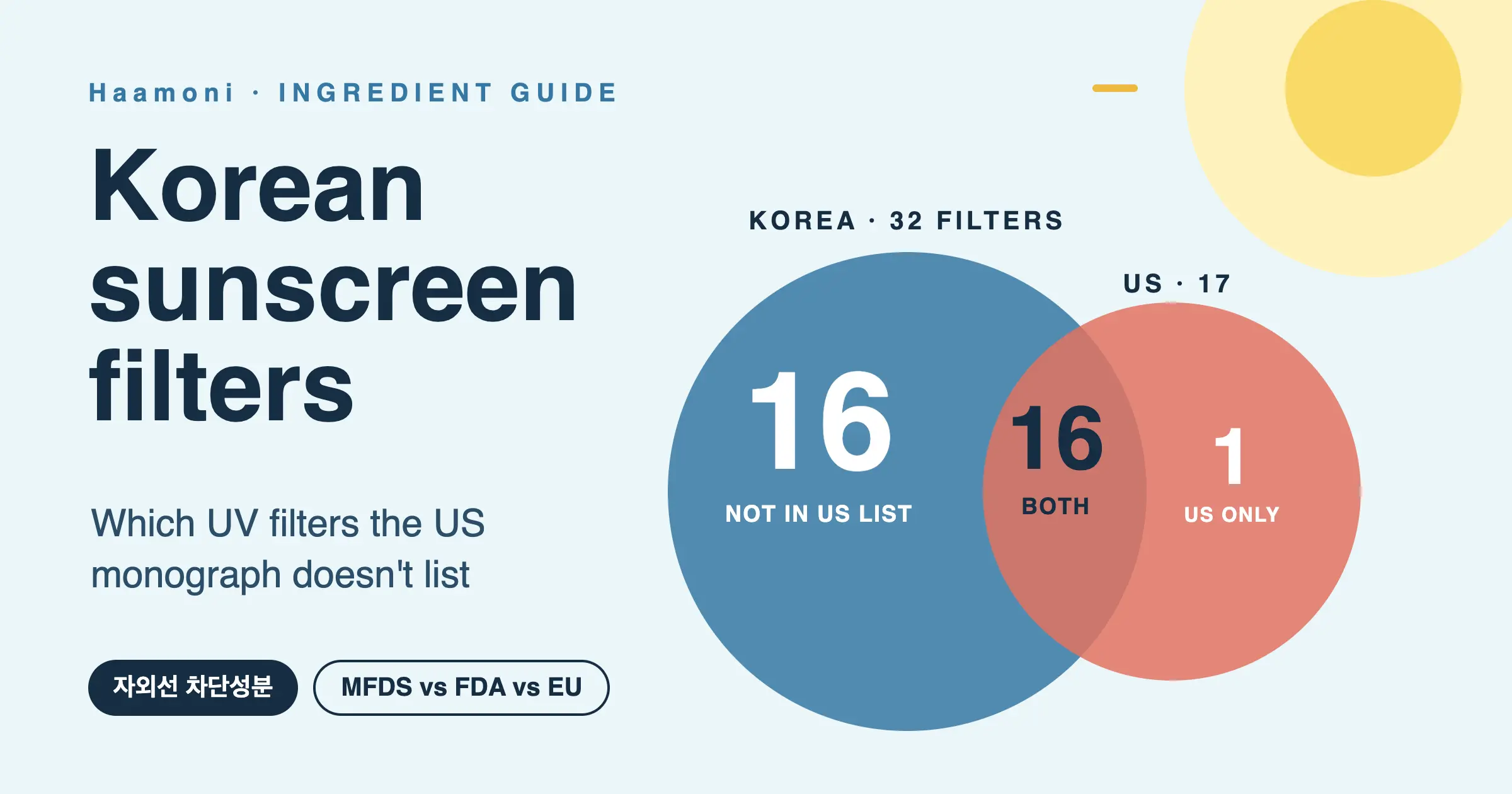
Korean sunscreen filters go well beyond the US list. Korea’s MFDS rules allow 32, while the US sunscreen monograph names 17. Filters missing from the US list include Ethylhexyl Triazone, Diethylamino Hydroxybenzoyl Hexyl Benzoate and Methylene Bis-Benzotriazolyl Tetramethylbutylphenol.
Sixteen filters sit on both lists. The other sixteen have no slot in the US monograph, although one of them, ecamsule, still turns up in sunscreens sold there. So a Korean tube and a US tube of the same brand can carry different filters. Read the filter names on the label, not just the brand.
What counts as a Korean sunscreen filter?
A UV filter is the ingredient that absorbs or blocks ultraviolet light. Zinc oxide and titanium dioxide are the two mineral filters. The rest are organic, meaning carbon-based, filters.
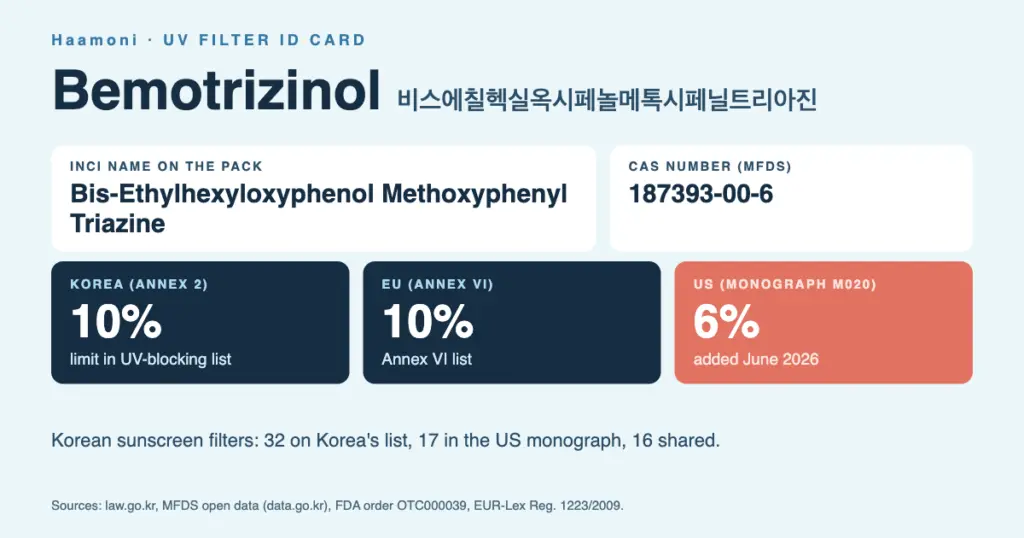
Korea lists them in one annex of its cosmetic safety rules, under the heading 자외선 차단성분 (UV-blocking ingredients). The annex uses Korean names, while English-language ingredient lists use the INCI name. Bemotrizinol, for example, is 비스에칠헥실옥시페놀메톡시페닐트리아진 in Korean and Bis-Ethylhexyloxyphenol Methoxyphenyl Triazine (CAS 187393-00-6) on an ingredient list.
The bigger difference is how each country files sunscreen. FDA says some countries regulate sunscreens as cosmetics, while the US regulates them as drugs. Korea sits on the cosmetic side, so its list lives in a cosmetics rule. The US list lives in a drug monograph, where each filter has to earn its place.
When you check a label, match its English names against the tables below.
Is sunscreen still a hot topic in Korea?
It cools off with the weather. Clicks on 선크림 (sunscreen cream) in Naver’s beauty category fell about a quarter over the last four weeks, compared with the four weeks before. Over those same four weeks it drew about twice as many clicks as 세럼 (serum) in the category.
I wrote about that slowdown in my weekly trends post. Autumn is a calm moment to compare labels before you buy for next summer.
Which Korean sunscreen filters are missing from the US list?
Here is the full set of Korean filters that the US monograph doesn’t name. I put the EU’s Annex VI beside them, because that is where most of these filters are also allowed.
| Filter missing from the US monograph (INCI name) | Korea limit | EU Annex VI |
|---|---|---|
| Drometrizole Trisiloxane | 15% | 15% |
| Drometrizole | 1.0% | not on EU Annex VI |
| Digalloyl Trioleate | 5% | not on EU Annex VI |
| Disodium Phenyl Dibenzimidazole Tetrasulfonate | 10% as acid | 10% as acid |
| Diethylhexyl Butamido Triazone | 10% | 10% |
| Diethylamino Hydroxybenzoyl Hexyl Benzoate | 10% | 10% |
| Methylene Bis-Benzotriazolyl Tetramethylbutylphenol | 10% | 10% |
| 4-Methylbenzylidene Camphor | 4% | Banned: can’t be placed on the EU market from May 1, 2025, or sold from May 1, 2026 |
| Methoxypropylamino Cyclohexenylidene Ethoxyethylcyanoacetate | 3% | 3% |
| Ethyl Dihydroxypropyl PABA | 5% | not on EU Annex VI |
| Ethylhexyl Triazone | 5% | 5% |
| Isoamyl p-Methoxycinnamate | 10% | 10% |
| Polysilicone-15 | 10% | 10% |
| Phenylene Bis-Diphenyltriazine | 5% | 5% |
| Terephthalylidene Dicamphor Sulfonic Acid (ecamsule) | 10% as acid | 10% as acid |
| Tris-Biphenyl Triazine | 10% | 10% |
Twelve of the sixteen are also on the EU list. That makes the US the outlier, not Korea. Korea’s list has no plain aminobenzoic acid (PABA), the one US filter it skips.
Four of them are missing from the EU list too: drometrizole, digalloyl trioleate, ethyl dihydroxypropyl PABA and 4-methylbenzylidene camphor (4-MBC). The EU banned 4-MBC outright, while Korea still allows it up to a limit. I can’t tell you how many Korean products still use any of the four.
Ecamsule is the odd one out. It isn’t in the monograph list, yet FDA’s consumer page names it among sunscreen actives. I couldn’t confirm how it reached the US market.
If you live in the EU, look for 4-Methylbenzylidene Camphor on an imported Korean sunscreen’s ingredient list.
Did the US just add one of the Korean filters?
Yes. FDA’s final order of June 10, 2026 added bemotrizinol to the monograph, at up to 6 percent. The order was set to take effect on August 9, 2026, and FDA’s consumer page now lists bemotrizinol as a permitted sunscreen ingredient.
There is a catch. The order gives the company that asked for it, DSM Nutritional Products, 18 months of exclusive marketing rights. I’d expect few US sunscreens to carry bemotrizinol soon, so a Korean tube built around it may stay hard to match.
Before assuming a US version matches the Korean one, look for bemotrizinol in its Drug Facts box.
Do the limits match on the filters both countries share?
Mostly, but not everywhere. Korea lets avobenzone run higher than the US does. Korea caps oxybenzone lower than the US in every product type, and homosalate sits between the EU and US figures. The table shows only the filters whose limits differ between Korea and the US.
| Filter | Korea limit | EU Annex VI | US monograph |
|---|---|---|---|
| Avobenzone | 5% | 5% | 3% |
| Bemotrizinol | 10% | 10% | 6% (final order June 10 2026, effective Aug 9 2026) |
| Cinoxate | 5% | not on EU Annex VI | 3% |
| Homosalate | 10% | 7.34% face products excl. propellant sprays | 15% |
| Oxybenzone (BP-3) | 2.4% (5% face, hands, lips) | 6% face/hand/lip excl. propellant+pump sprays; 2.2% body; 0.5% other | 6% |
| Sulisobenzone (BP-4) | 5% | 5% as acid | 10% |
The rest, including zinc oxide, titanium dioxide, octocrylene, octisalate and padimate O, share the same ceiling in Korea and the US. These are legal ceilings, not what a tube contains, so a cap tells you little about a specific product.
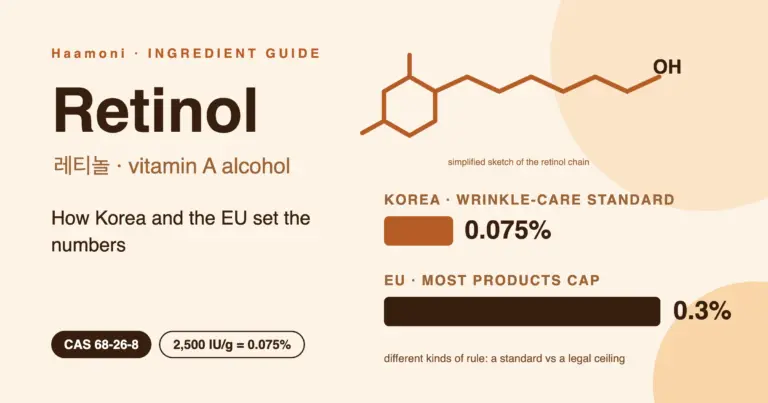
Retinol is a different story: Korea and the EU set different kinds of limits, which I covered in my retinol post.
If a limit matters to you, check the filter’s cap in the table before assuming a US tube matches a Korean one.
What does the evidence say about these filters?
The best human data cover filters sold in the US. Two randomized trials in JAMA (2019 and 2020) tested sunscreens under heavy-use conditions, and every filter tested reached blood levels above FDA’s 0.5 ng/mL screening threshold. The authors said this does not mean people should avoid sunscreen.
Absorption isn’t the same as harm. The threshold only tells FDA when to ask for more safety studies. The trials covered avobenzone, oxybenzone, octocrylene, homosalate, octisalate, octinoxate and ecamsule. None of the other filters missing from the US list were in them.
For bemotrizinol, FDA’s order says the submitted studies showed it isn’t readily absorbed through human skin, even with repeat use. It also reports no irritation or phototoxicity in the skin studies. That is the company’s data as reviewed by FDA, not an independent trial.
I couldn’t find matching absorption trials for the rest of Korea’s list. So a longer list doesn’t make Korean sunscreen better or safer. It makes it a longer menu.
Choose on your skin and the label, not on how many filters a country allows.
What do Korean sunscreens look like on the shelf?
Korean shoppers sort sunscreens by form: creams (선크림), serums (선세럼) and sticks (선스틱). In Naver’s beauty category, cream gets far more clicks than sticks, and sticks more than sun serums.
Listings also use 무기자차 (mineral sunscreen) and 유기자차 (organic, often called chemical, sunscreen). Mineral ones rely on zinc oxide or titanium dioxide. Organic ones rely on the carbon-based filters in the table above, and hybrids use both.
Sunscreen also has to come off at night, which is the question in my Jumiso cleansing milk post. If you only want zinc oxide or titanium dioxide, search listings for 무기자차.
Who needs to read the filter list closely?
- Anyone who buys a Korean sunscreen abroad and expects the Korean formula. Match the US Drug Facts active ingredients against the English ingredient list on the Korean pack.
- EU residents buying imports. Look for 4-MBC, which the EU no longer allows on its market.
- Anyone who has reacted to a sunscreen before. Note which filters were in it and compare them against the next label.
- People with sensitive or reactive skin, or who are pregnant. Ask a dermatologist before changing sunscreen.
What would I check on an imported sunscreen?
I wouldn’t prefer Korean sunscreen for its longer filter list, and I wouldn’t avoid American ones for the shorter one. What I would do is compare filter names. Monograph sunscreens draw their actives from that list. So a US tube with a Korean name often can’t copy a Korean formula that relies on filters the US list lacks.
Put the Korean pack’s English ingredient list next to the US Drug Facts box before you buy.
The short version
Korea allows nearly twice as many UV filters as the US monograph, and half of Korea’s list has no US slot. Most of those filters are allowed in the EU, bemotrizinol only joined the US list in 2026, and a longer list doesn’t prove better protection.
Some links on Haamoni may be affiliate links. If you buy through one, I may earn a small commission at no extra cost to you. As an Amazon Associate I earn from qualifying purchases. This post is not medical advice.
Sources
- Korea, Cosmetic Safety Standards regulation, Annex 2: UV-blocking ingredients, version in force from March 18, 2026 (law.go.kr)
- MFDS cosmetic ingredient database (data.go.kr)
- MFDS restricted cosmetic ingredients by country (data.go.kr)
- MFDS cosmetic ingredient regulation list (data.go.kr)
- FDA, Final Administrative Order OTC000039 amending OTC Monograph M020: Sunscreen Drug Products (issued June 10, 2026)
- FDA, Sunscreen: How to Help Protect Your Skin from the Sun
- Regulation (EC) No 1223/2009, consolidated text of May 1, 2025, Annexes II and VI (EUR-Lex)
- Matta et al., Sunscreen application under maximal use conditions and plasma concentrations, JAMA 2019 (PubMed)
- Matta et al., Effect of sunscreen application on plasma concentration of sunscreen active ingredients, JAMA 2020 (PubMed)
- Naver DataLab Shopping Insight, beauty category keyword clicks