Retinol Skincare in Korea vs the EU: Is Korean Retinol Weaker?
Retinol skincare gets talked about as if one number applied everywhere. It doesn’t. This week I looked at how Korea and the EU actually write the rules for retinol (레티놀), using Korea’s MFDS data, the EU’s 2024 regulation and three studies.
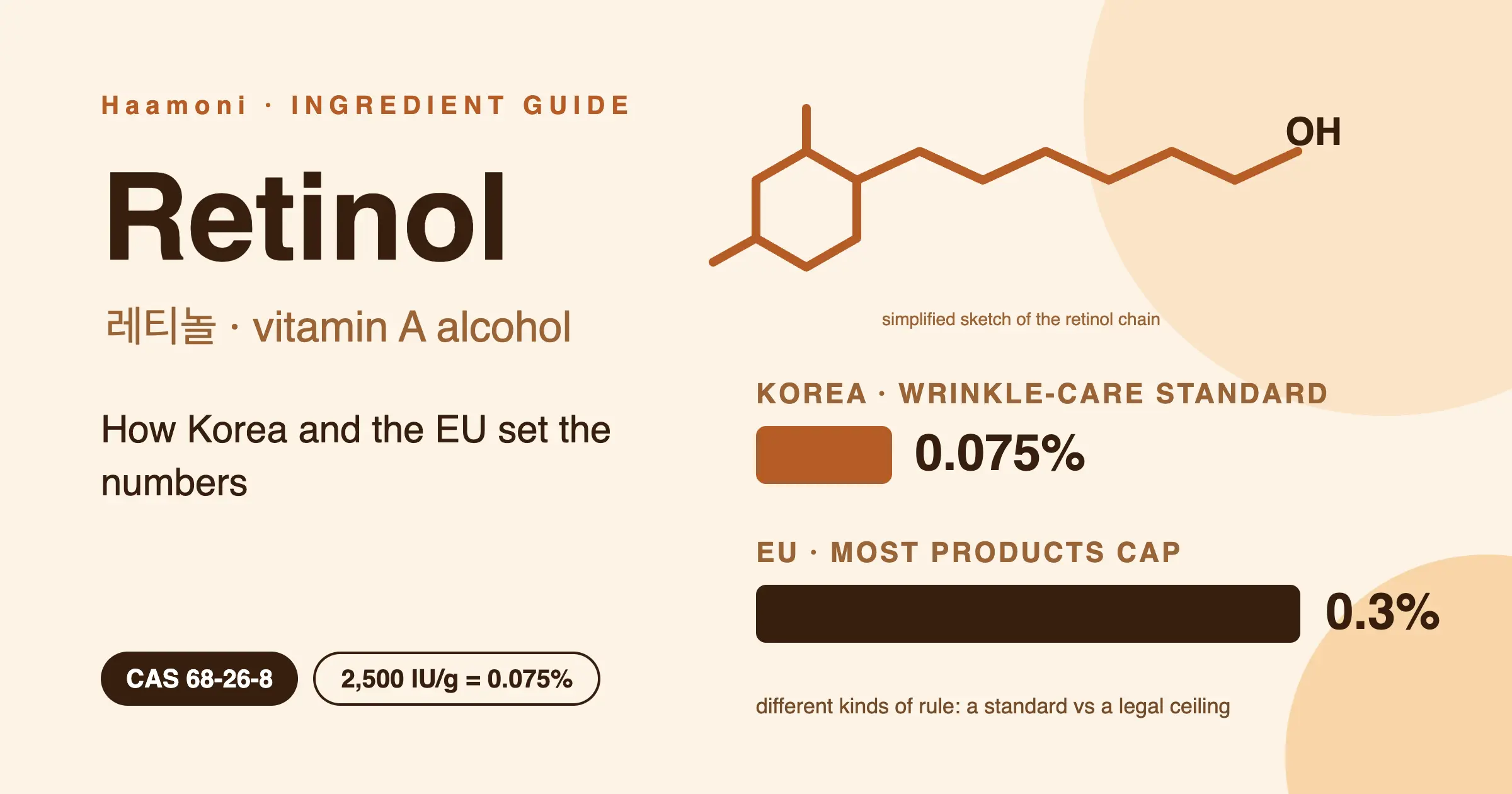
The EU now caps retinol at 0.3% in most leave-on and rinse-off products and at 0.05% in body lotion. Korea’s wrinkle-care standard sits at about 0.075%. Those two numbers measure different things, though, and I couldn’t find a Korean ceiling to compare with the EU’s.
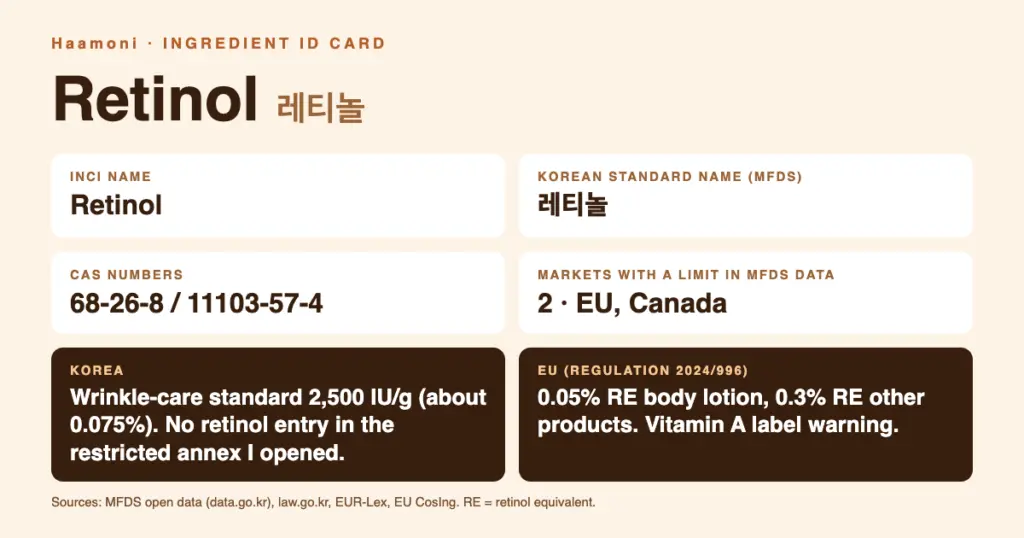
What retinol is and what Korea calls it
Retinol is vitamin A in its alcohol form. It is a long-used ingredient in wrinkle-care products. Korea’s MFDS ingredient database lists the standard name 레티놀 with the English (INCI) name Retinol. A second entry, Hydrogenated Retinol, is a derivative made by adding hydrogen to retinol.
Retinal, the next step up the vitamin A ladder, is filed under the standard name 레틴알. The database lists 레티날 as a synonym, so search for either spelling. The restricted-ingredient records give two CAS numbers for retinol: 68-26-8 and 11103-57-4. The EU’s CosIng database shows the same two numbers and files retinol under Annex III, entry 376.
How much interest retinol gets in Korea
In Naver Shopping Insight, clicks on retinol in the beauty category rose about 5% over the last four full weeks. That compares with the four weeks before, and I left out the unfinished current week. So the interest is steady, not surging.
The size of the keyword is the bigger story. Retinol’s click level is about 2.5 times that of “serum”, my reference keyword. Among the ingredient keywords I track, only niacinamide ranks above it. Retinal sits near the level of “serum” itself, roughly a third of retinol, and slipped about 4% over the same period.
For a real Korean label, see my post on the IOPE Retinol Super Bounce Serum. It states 509 IU/g of retinol. I can’t tell you why Korean shoppers are clicking, since the data doesn’t say.
What the evidence says about retinol skincare
Retinol has real research behind it, although most of it is small or mixed. These are the three sources I opened.
- A 2025 network meta-analysis in Scientific Reports pooled 23 randomized trials with 3,905 people. Retinol, tretinoin (the prescription form) and isotretinoin all improved fine wrinkles. Retinol and tretinoin also did better on uneven pigment. The authors list limited racial diversity and possible commercial bias as weaknesses. Four of them are affiliated with a company research institute (HBN, Shenzhen Hujia Technology), although they declare no competing interests.
- A 2019 trial in the British Journal of Dermatology compared retinol 0.5% with bakuchiol 0.5% in 44 people over 12 weeks. Both cut wrinkle surface area and pigmentation, with no statistical difference between them. The retinol group reported more scaling and stinging.
- A 2020 pilot study in the Journal of Cosmetic Dermatology tried retinol 0.15% on one side of the face and 0.3% on the other, in 40 people for eight weeks. Both strengths improved overall skin condition, side effects were minimal, and the two sides didn’t differ significantly. The authors call for a longer study.
Here is what these studies don’t tell us. None of them tested the 0.075% level in Korea’s standard. The strengths, formulas and lengths differ, so you can’t line them up into one dose curve. The 0.5% trial used more than the EU now allows in cosmetics, and the pilot suggests a higher strength didn’t clearly beat a lower one. So the honest reading is that retinol is studied for wrinkles and pigment, and that the best dose for a store-bought product is still open.
Korea vs the EU: how the retinol rules differ
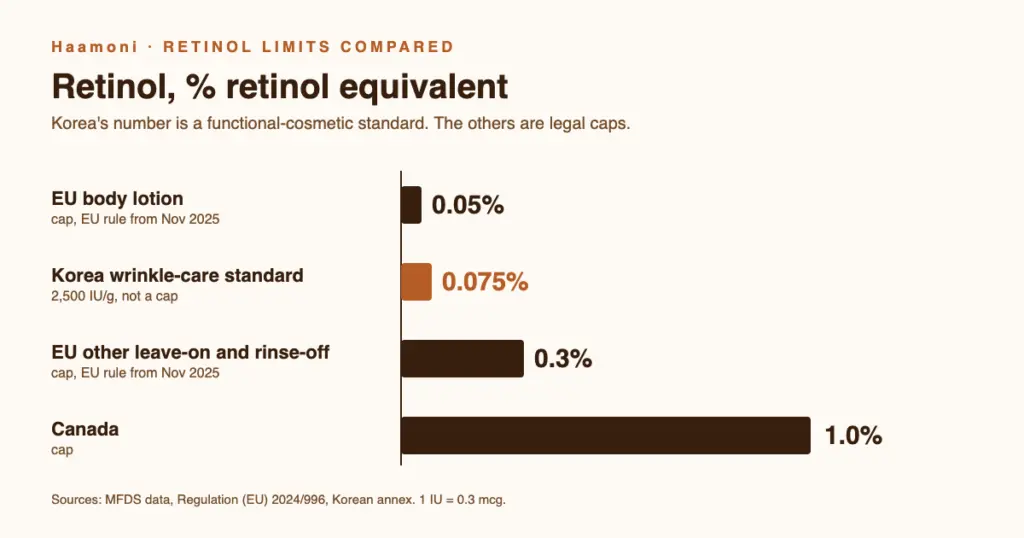
I checked the MFDS restricted-ingredient and country-regulation lists. Retinol has limit entries for exactly two markets, the EU and Canada. Nothing sits on the banned list, and no Korean entry appears there.
| Market | What the rule says | Where I found it |
|---|---|---|
| Korea | Wrinkle-care functional cosmetics list retinol at 2,500 IU/g, about 0.075%. That applies to lotions, liquids, creams, solid forms and soaked masks. | MFDS functional cosmetics annex on law.go.kr |
| Korea (restricted list) | I found no retinol entry in the current restricted-ingredient annex, in force since March 18, 2026. | Korea’s cosmetic safety standards, Annex 2 |
| EU | Maximum 0.05% retinol equivalent (RE) in body lotion and 0.3% RE in other leave-on and rinse-off products. Label must say: Contains Vitamin A. Consider your daily intake before use. | Regulation (EU) 2024/996, Annex III; MFDS data |
| Canada | Maximum 1.0% retinol equivalent. Esters have their own caps, 1.15% for retinyl acetate and 1.83% for retinyl palmitate. | MFDS restricted-ingredient data |
| Other markets in the MFDS data | No retinol entry | MFDS regulation list |
The conversion matters here. NIH counts 1 IU of retinol as 0.3 micrograms. So 2,500 IU per gram works out to 750 micrograms per gram, or 0.075%. The EU’s 0.3% for most products is about 10,000 IU/g, four times that. Its 0.05% body-lotion cap is about 1,667 IU/g, lower than Korea’s wrinkle-care level.
Now the catch. Korea’s number comes from the list of functional cosmetics that can skip extra data submission, and the column is headed “content”, not “maximum”. The EU number is a legal ceiling. They are not the same kind of rule, so don’t read Korea as “stricter” or “looser”. I found no retinol entry in Korea’s current restricted-ingredient annex, but I can’t rule out limits set elsewhere in Korean rules.
Not every Korean retinol product matches that figure either. The IOPE serum states 509 IU/g, about 0.015%, and it has an MFDS functional-cosmetic report. I haven’t confirmed which route it took.
The EU timeline is easy to miss. The regulation took effect in 2024 after the EU’s safety committee (SCCS) reviewed vitamin A in 2022. Since November 1, 2025, products that don’t comply can’t be placed on the EU market. Stock already on shelves can stay available through April 2027. The regulation gave industry extra time because current products already sit within the safe levels. The concern the regulation cites is the total vitamin A you get from food, supplements and cosmetics.
One last data note. MFDS functional-cosmetic records include 767 reports with 레티놀 in the product name. The public dataset returned only the first ten records, all filed between 2009 and 2013. Since the dataset is old and partial, I wouldn’t use it to count products.
Who retinol suits, and who should be careful
- People who already use a gentle routine and want to try a wrinkle-care ingredient. The 0.5% trial found more scaling and stinging with retinol than with bakuchiol.
- Anyone using several vitamin A sources. The EU label warning is aimed at people who already get a lot from food and supplements. NIH puts the adult upper limit for preformed vitamin A at 3,000 micrograms per day.
- Sensitive or reactive skin may find retinol irritating. Check the full ingredient list for fragrance and acids as well.
- If you are pregnant, might become pregnant or are breastfeeding, ask a doctor or dermatologist first. NIH says high-dose vitamin A supplements carry a birth-defect risk, and the same fact sheet notes some retinoid medicines can do the same.
- The IOPE usage notes say to wear sunscreen in the morning.
What retinol looks like in Korean products
In the ten MFDS functional-cosmetic records I could see, retinol shows up in serums, eye creams and night products. Those date from 2009 to 2013, so treat this as a partial picture. These are product types, not a ranking of what to buy. The IOPE label and Korea’s annex both give the strength in IU per gram instead of a percentage. So a label can say 509 IU/g and still look unclear to a visitor.
To read one, look for Retinol (레티놀) on the ingredient list, then for an IU figure in the product notes. Multiply the IU by 0.3 and divide by 10,000 to get a percentage. For example, 1,000 IU/g gives 0.03%. Some products add retinol esters such as retinyl palmitate, which appear under their own names.
If you like this kind of label-reading, I did the same for ceramides.
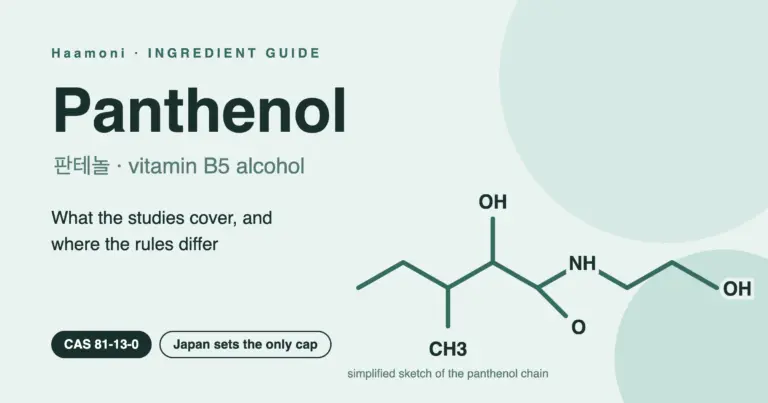
The ingredient guide on panthenol shows how a limit set by only one country looks in the same MFDS data.
Haamoni product posts that look at retinol
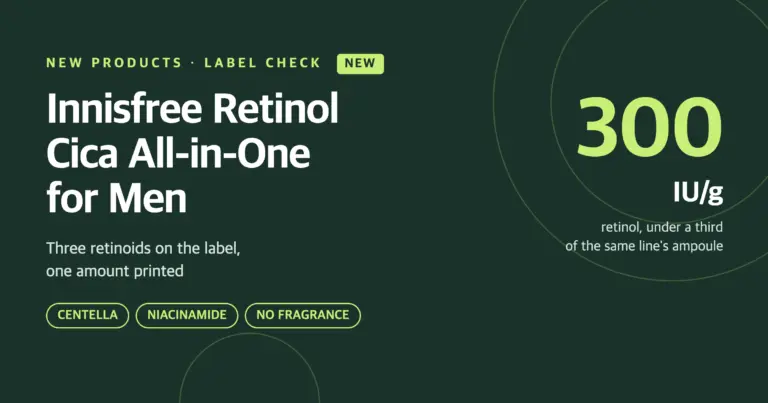
- Innisfree Retinol Cica All-in-One Review: Worth It, or Buy the Ampoule?
- Pro-Calm Retinoate Cream Review: Korea’s New Pharmacy Retinoid, Explained
- IOPE Retinol Super Bounce Serum (Expert RX 1%) Review: How Strong Is It?
The short version
Korea’s wrinkle-care standard puts retinol at about 0.075% (2,500 IU/g), while the EU now caps most products at 0.3% and body lotion at 0.05%. The numbers aren’t the same kind of rule, and studies support retinol for wrinkles and pigment but not a best dose.
Some links on Haamoni may be affiliate links. If you buy through one, I may earn a small commission at no extra cost to you. As an Amazon Associate I earn from qualifying purchases. This post is not medical advice.
Sources
- MFDS cosmetic ingredient database (data.go.kr)
- MFDS restricted cosmetic ingredients by country (data.go.kr)
- MFDS cosmetic ingredient regulation list (data.go.kr)
- MFDS functional cosmetics report data (data.go.kr)
- Korea, Regulation on the Examination of Functional Cosmetics, Annex 4, current version (law.go.kr)
- Korea, Cosmetic Safety Standards regulation, Annex 2: ingredients with restrictions, current version (law.go.kr)
- Commission Regulation (EU) 2024/996 (EUR-Lex)
- EU CosIng database: Retinol, Annex III entry 376
- Lin et al., Comparative efficacy of topical interventions for facial photoaging, Sci Rep 2025 (PubMed)
- Dhaliwal et al., Topical bakuchiol and retinol for facial photoageing, Br J Dermatol 2019 (PubMed)
- Zasada and Budzisz, Two concentrations of retinol on aging skin: pilot study, J Cosmet Dermatol 2020 (PubMed)
- NIH Office of Dietary Supplements, Vitamin A fact sheet for health professionals
- Olive Young Korea, IOPE Retinol Super Bounce Serum product page
- Naver DataLab Shopping Insight, beauty category keyword clicks