K-Beauty Trends This Week: Ceramides Climb as Sunscreen Fades
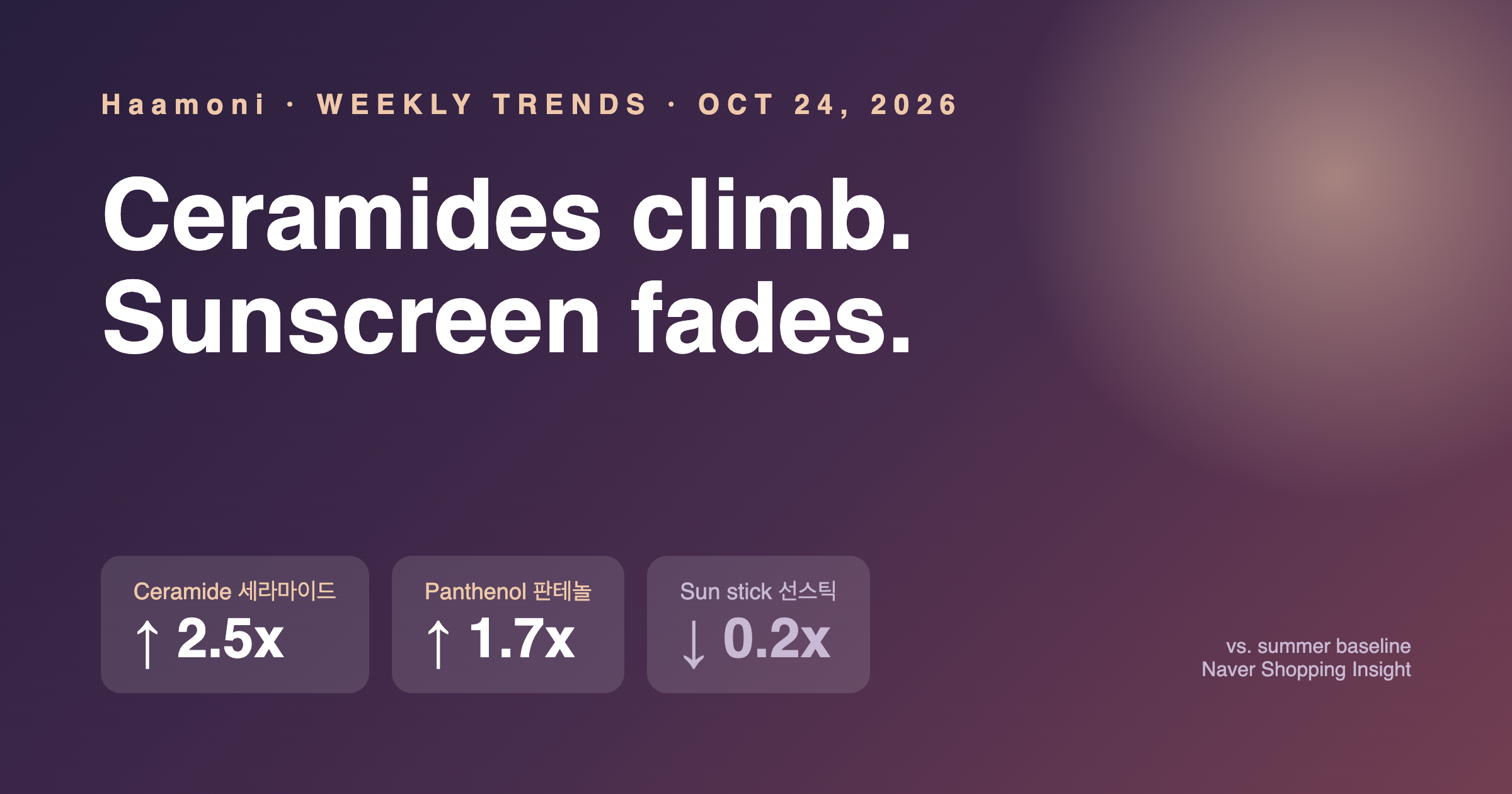
These K-beauty trends come straight from Korean shopping data, and this week the story is simple. Korea is putting the sunscreen away and reaching for barrier care. I pulled 16 weeks of click data from Naver Shopping Insight, the trend tool for Korea’s biggest shopping search, and compared 39 beauty keywords. Ceramide and panthenol are climbing, while sun sticks have dropped to a fraction of their summer level.
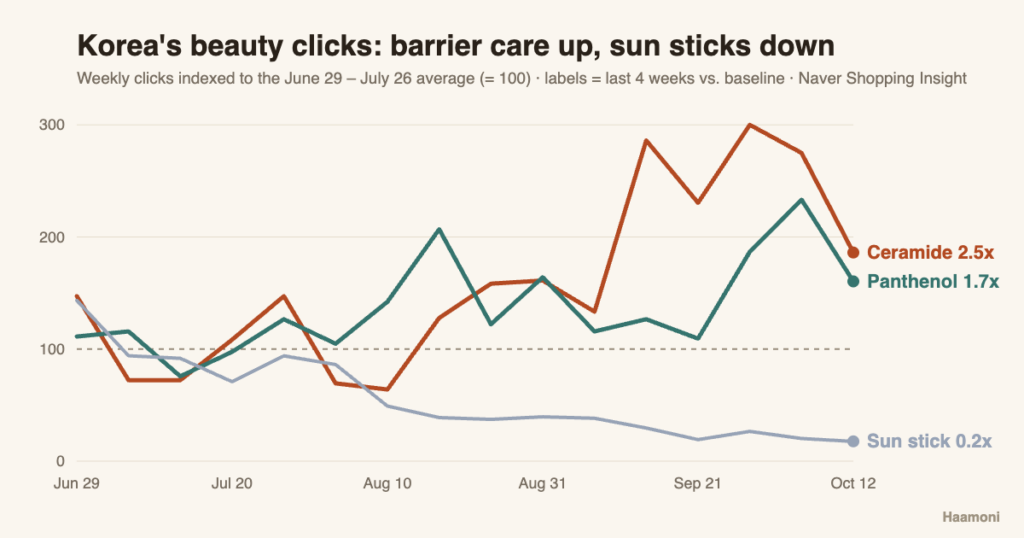
A quick note on the numbers before we start. Naver does not share raw search counts. Instead, it gives relative clicks, so I only compare each keyword with its own past. In this post, the baseline is the average of the first four weeks of the window (June 29 to July 26, 2026), and “now” means the four full weeks from September 21 to October 18.
K-beauty trends at a glance
Here is the short table. A value of 2.5x means clicks in the last four weeks were about two and a half times the summer baseline.
| Keyword (Korean) | Now vs. summer | What I think is going on |
|---|---|---|
| Ceramide (세라마이드) | about 2.5x | Dry-air season and barrier creams |
| Panthenol (판테놀) | about 1.7x | Soothing care for wind and cold |
| Hyaluronic acid (히알루론산) | spiked, now cooling | Peaked around Chuseok and a big sale |
| Exosome (엑소좀) | bouncing back | Small keyword, very noisy |
| Retinol (레티놀) | about flat | Still huge, but not growing |
| Sun stick (선스틱) | about 0.2x | Summer is over |
Ceramide is the quiet winner
Ceramide clicks sat at a low, steady level all through July and August. Then September arrived, and the line jumped. By late September, weekly clicks were roughly three times the summer average, and they stayed high into October.
Ceramides are lipids that already exist in the outer layer of skin. That is why brands lean on them for “barrier” products. Korea’s Ministry of Food and Drug Safety (MFDS) lists the common form as Ceramide NP (세라마이드엔피) in its cosmetic ingredient database, so that is the name to look for on an ingredient list.
I also opened Olive Young’s best-seller page this week, only as a signal. Ceramide-based barrier creams were easy to spot near the top. That matches the click data, and honestly it matches what I would expect when the air in Korea turns cold and dry.
Still, keep the scale in mind. Compared with a big word like sunscreen, ceramide is a much smaller search term. So this is a fast-growing niche, not the biggest category.
Panthenol rides the same wave
Panthenol, a form of vitamin B5, moved in the same direction. It peaked in the week of October 5 at a little over twice its summer level, then eased a bit. In Korean stores, it usually shows up in soothing creams, sprays and cica-style products.
One detail surprised me in the MFDS regulation data. Korea sets no special cap on panthenol in cosmetics. However, the MFDS list of restricted ingredients by country shows Japan limits it in leave-on products, at 8 g per 100 g for DL-panthenol and 3 g for D-panthenol. For most people this changes nothing. But it explains why the same product can be formulated a little differently from market to market.
Hyaluronic acid spiked, then cooled
Hyaluronic acid behaved differently. It is a big keyword, and it jumped hard in the week of September 21, to its highest point in my window. After that, it slid back down through October.
The timing lines up with two things. Chuseok, Korea’s autumn holiday, ran from September 24 to 26, and Olive Young’s monthly sale, Olive Young Day, ran September 25 to 27. Gift shopping and a sale in the same week is a pretty good recipe for a spike. That said, I can’t prove the link from this data alone, so treat it as my best guess.
Exosome is loud, but small
If you only looked at the four-week change, exosome would top my list. It is up a lot compared with the four weeks before. However, the longer view tells a different story. Exosome clicks fell in August and are mostly bouncing back to where they were in July. On top of that, it is a small keyword, so a few busy days can swing the line.
Even so, it is worth understanding, because the word means different things in different places. In the MFDS ingredient database, the exosome entries I found come from milk, salmon testis, Pacific cod testis and Lactobacillus. Meanwhile, clinic brands are launching plant-derived exosome products, such as one made with tomato callus exosomes. Also, back in 2022 the head of MFDS told lawmakers that, for cosmetics, the agency checks for banned ingredients rather than reviewing how each one is made, according to a Dailypharm report on that hearing.
So when a product says “exosome” on the box, I would look at the full ingredient list to see what the source actually is.
What is fading: sunscreen and sun sticks
No surprise here, but the size of the drop is striking. Sun sticks were one of the hottest summer items, and clicks are now around a fifth of the July level. Sunscreen as a whole is down to roughly half.
Personally, I would not read this as advice to stop using sunscreen. It is just Korean shoppers moving their money to the season’s bigger worry, which is dryness.
Retinol: still big, not growing
Retinol is the largest active ingredient by clicks in my keyword set, at about two and a half times the level of the word “serum” itself. Yet it is basically flat against summer. In other words, retinol is a steady habit in Korea right now, not a new trend.
What I’ll watch next week
- Whether ceramide holds its level or starts to fade after the first cold snap.
- Whether panthenol picks up again as wind and heating dry skin out.
- Whether exosome keeps rising past its July level, which would make it a real trend instead of a rebound.
Also, I’ll keep adding new keywords as they show up in Korean shops, so the list should get sharper over time.
The short version
Korean shoppers are swapping sunscreen for barrier care: ceramide clicks on Naver are about 2.5x their summer level and panthenol about 1.7x, while sun sticks fell to roughly a fifth. Hyaluronic acid spiked around Chuseok and then cooled, and exosome is a small, noisy rebound rather than a clear trend so far.
Some links on Haamoni may be affiliate links. If you buy through one, I may earn a small commission at no extra cost to you. This post is not medical advice.
Sources
- Naver DataLab Shopping Insight, beauty category keyword clicks (June 29 to October 18, 2026)
- MFDS cosmetic ingredient database (data.go.kr)
- MFDS restricted cosmetic ingredients by country (data.go.kr)
- Olive Young best sellers page (checked October 24, 2026)
- Chuseok 2026 dates, kholidayz.com
- Olive Young Day September 2026 sale dates, UNPA
- Humedix plant-derived exosome launch, Hankyung (June 25, 2026)
- MFDS comments on exosome cosmetics at the 2022 National Assembly audit, Dailypharm