Shin Ramyun Ingredients: Korean Pack Lists Pork, the US Pack Doesn’t
Shin Ramyun (신라면) is Nongshim’s spicy beef-broth instant noodle, the one in the red pack. It’s a fried wheat noodle with a chili and beef seasoning powder, sold as a bag, a small cup and a big bowl. However, the pack you buy in Seoul and the one on Amazon in the US aren’t made from the same ingredient list.
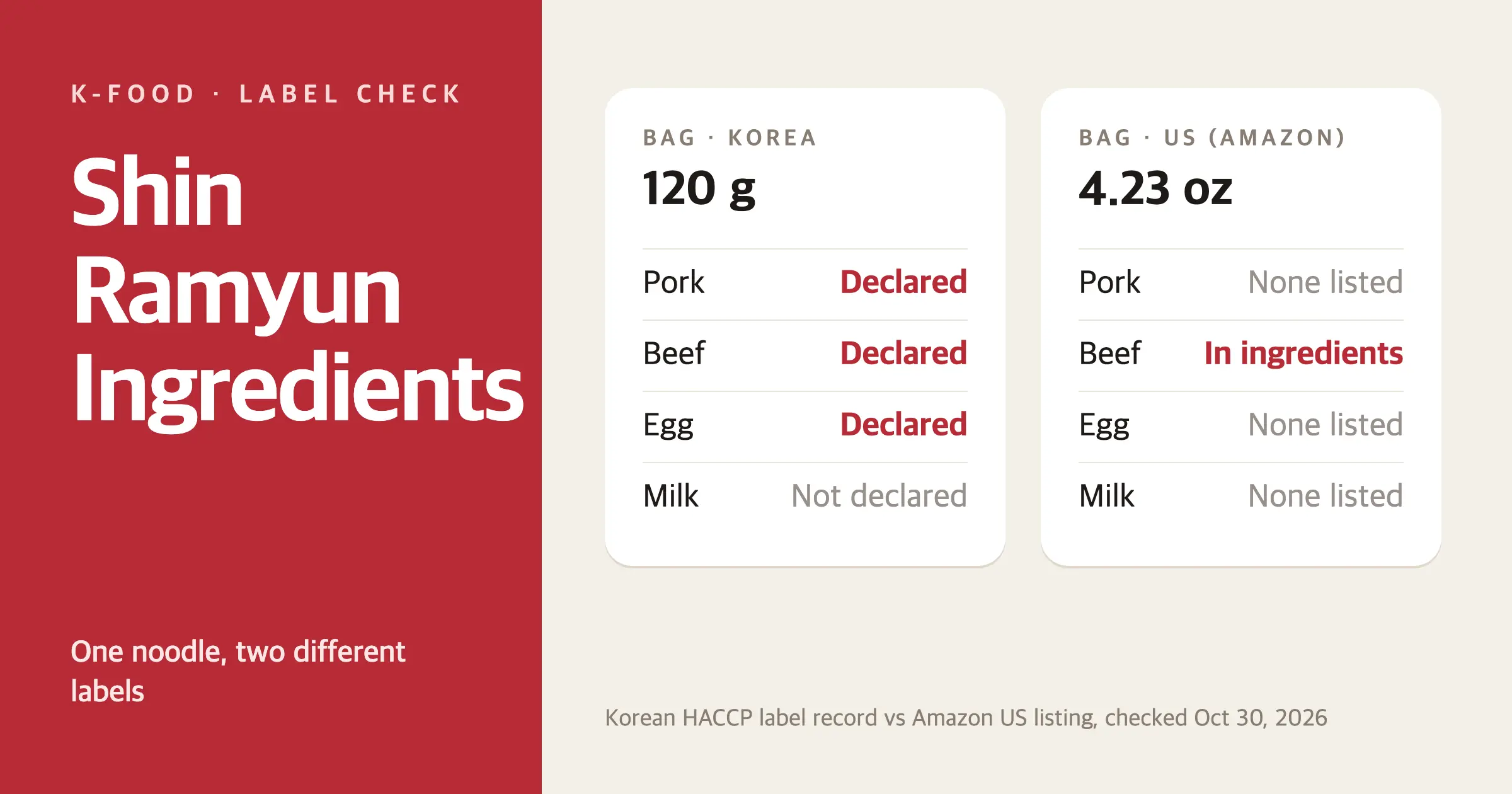
The Korean bag declares pork, beef and egg. The US 20-pack on Amazon declares only wheat and soy, with beef but no pork in its ingredients. So if you’re checking this noodle for a diet, the country on the pack matters more than the flavor name.
To see how far that goes, I set four Korean versions next to the US listing. On the Korean side, every number is from HACCP records. HACCP is Korea’s food-safety certification, and certified makers file their pack labels with it; the government’s data portal publishes those filings.
Four Korean Shin Ramyun packs, side by side
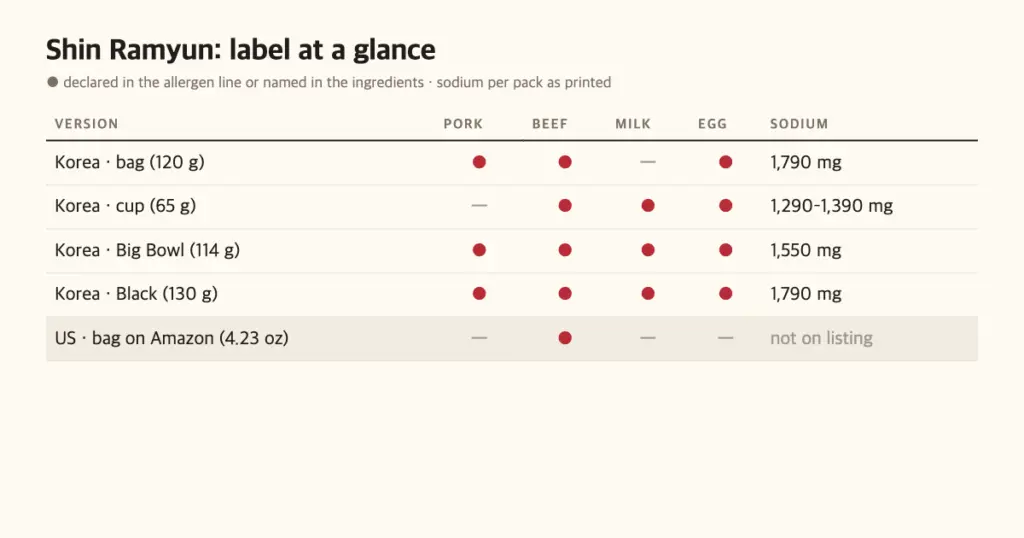
| Product (Korea) | Size | Calories | Sodium | Allergen line on the Korean label |
|---|---|---|---|---|
| Shin Ramyun, bag | 120 g | 500 kcal | 1,790 mg (90%) | Wheat, soy, pork, egg, beef |
| Cup (신라면컵) | 65 g | 290 kcal | 1,290 mg (65%) to 1,390 mg (70%) | Wheat, soy, milk (whey), egg (one of two records; the other leaves it blank) |
| Big Bowl (큰사발) | 114 g | 515 kcal | 1,550 mg (78%) | Wheat, soy, pork (lard), milk, egg |
| Black (신라면 블랙), bag | 130 g | 560 kcal | 1,790 mg (90%) | Wheat, soy, pork, beef, milk, egg |
Percentages are the share of Korea’s daily sodium reference value, as printed. The two cup records list different sodium figures, so I gave both. Also, Nongshim’s brand page now lists 490 kcal for the Big Bowl and 300 kcal for the cup, and its official mall sells Black in 134 g packs. Recipes get small updates, so the pack in your hand may differ a little from these records.
Pork, beef, egg: reading the Korean bag
The original Korean bag is built on beef. Its seasoning lists a beef flavor base, seasoned beef powder and a beef-bone garlic seasoning. Mixed in among them is 돈골조미분말: a seasoning powder made from pork bone. That’s why pork sits in the allergen line.
Egg shows up for a less obvious reason. The noodle dough contains eggshell calcium (난각칼슘), and the labels count it as egg. Milk, on the other hand, isn’t declared on the original bag.
- Cup: no pork-named ingredient appears in the list. Still, it has seasoned beef powder and a beef soup powder, and its allergen line declares milk (whey) and egg.
- Big Bowl: it uses a beef-flavor paste and declares lard (돈지), so pork is back. It also lists lactose, which is why milk appears.
- Black: the premium version adds bone broth powders and pieces of cooked beef. Its allergen line is the longest of the four.
Blended seasonings don’t always name what’s inside them. So when a pack declares pork or milk, treat that as true even if you can’t spot the ingredient by name.
Korea vs US: same name, different label
The US version on Amazon lists Nong Shim America as its manufacturer. The listing itself says the product is labeled to US standards and may differ from versions sold elsewhere. Here’s how the two bags compare on the points people usually check.
| Korean bag (120 g) | US bag on Amazon (4.23 oz) | |
|---|---|---|
| Allergens declared | Wheat, soy, pork, egg, beef | Wheat, soy |
| Pork ingredient | Pork-bone seasoning powder | None listed |
| Beef ingredients | Beef flavor base, seasoned beef powder, beef-bone seasoning | Beef bone extract, beef extract, beef fat |
| Egg | Eggshell calcium in the noodle | None listed; made in a facility that also processes eggs |
The two labels also flag different things. The Korean bag puts pork and beef in the allergen line itself, while the US line stops at wheat and soy even though the pack contains beef. Therefore, on a US pack, read the full ingredient list, not only the bold allergen line.
If you avoid pork, meat or dairy
Going by the labels, no version here is vegetarian or vegan. Every Korean pack contains beef ingredients, and the US pack lists beef bone extract, beef extract and beef fat.
Halal is a separate question, and I’m keeping it narrow. The Korean bag, Big Bowl and Black all declare pork, so they don’t fit a halal diet as labeled. The US pack lists no pork ingredient. Even so, pork-free on a label isn’t the same as halal, and the Amazon listing doesn’t mention a halal mark. If you need halal, look for a certification logo on the pack itself.
If I had to avoid pork, I’d buy the US pack over the Korean bag. The reason is the label: the US list names no pork, while the Korean bag lists a pork-bone seasoning.
What about Toomba and Gold?
Shin Ramyun Toomba (신라면 툼바) is the creamy, saucy version Nongshim launched in October 2024. Nongshim’s recipe has you pour off the water, leaving about 60 ml, before mixing in the sauce. According to Nongshim, the 137 g bag has 590 kcal and adds a soft cream to the Shin flavor. There’s also a 113 g Toomba Big Bowl at 500 kcal.
Gold came out in January 2026 for the brand’s 40th anniversary. Nongshim describes it as a chicken-broth version, 125 g and 540 kcal. Neither product came up in the HACCP label records I searched, so I’m not listing their allergens. Check the back of the pack for those.
No official spice number
Nongshim’s own product pages don’t give a Scoville figure for the original, Black or Toomba. I’d rather not quote a number I can’t trace to the company. If you want a milder bowl, the US listing suggests using two-thirds of the soup base or less.
Sodium on each Korean label
The table’s sodium numbers are per serving as printed, and for the bags one serving is the whole bag. One of the cup records adds a cooked figure: 410 mg per 100 g, broth included, when made by the standard recipe. Using less of the soup powder is the simple way to cut the total.
Shin Ramyun price in Korea, and where to buy it in the US
Here’s what Nongshim’s official Korean mall listed on October 30, 2026. I converted won at 1,337.29 won to the dollar, the ECB reference rate for October 29 via Frankfurter.
| Where | Pack | Price | Per pack |
|---|---|---|---|
| Nongshim Mall (Korea) | Bag, 5 × 120 g | 4,510 won ($3.37) | 902 won ($0.67) |
| Amazon US | Bag, 20 × 4.23 oz, shipped and sold by Amazon | Check the current price on Amazon → | Check the current price on Amazon → |
| Nongshim Mall (Korea) | Cup, 65 g | 1,430 won ($1.07) | 1,430 won ($1.07) |
| Nongshim Mall (Korea) | Big Bowl, 114 g | 1,650 won ($1.23) | 1,650 won ($1.23) |
| Nongshim Mall (Korea) | Black, 4 × 134 g | 6,160 won ($4.61) | 1,540 won ($1.15) |
| Nongshim Mall (Korea) | Toomba, 4 × 137 g | 5,280 won ($3.95) | 1,320 won ($0.99) |
Nongshim Mall charges 3,000 won shipping on orders under 30,000 won, which the per-pack figures don’t include. In the US, the original bag is shipped and sold by Amazon itself as a 20-pack. Since the original is that easy to get at home, I wouldn’t fill a suitcase with it. Black and Toomba are a different story if you can’t find them where you live.
Before you grab a pack in Korea
- On a Korean pack, find the allergen line next to the ingredient list. Look for 돼지고기 (pork), 쇠고기 (beef), 우유 (milk) and 계란 (egg).
- The cup and the Big Bowl aren’t just smaller and bigger bags. They have different ingredient lists, so check each one.
- For the noodle’s place among other Korean spicy ramen, see my Buldak ramen comparison, which reads the same kind of label data.
The short version
Shin Ramyun’s Korean bag declares pork, beef and egg, while the US pack on Amazon declares only wheat and soy and lists beef but no pork. No version is vegetarian, and a bag of the original costs 902 won (about $0.67) from Nongshim’s Korean mall.
Some links on Haamoni may be affiliate links. If you buy through one, I may earn a small commission at no extra cost to you. As an Amazon Associate I earn from qualifying purchases. Menus, prices and hours were correct when I checked and can change, so confirm before you go.
Sources
- HACCP product label data (Korea Agency of HACCP Accreditation and Services, data.go.kr)
- Nongshim brand site, Shin Ramyun product information (checked 2026-10-30)
- Nongshim brand site, Shin Ramyun Toomba product information (checked 2026-10-30)
- Nongshim Mall, Shin Ramyun 5-pack (checked 2026-10-30)
- Nongshim Mall, Shin Ramyun cup (checked 2026-10-30)
- Nongshim Mall, Shin Ramyun Big Bowl (checked 2026-10-30)
- Nongshim Mall, Shin Ramyun Black 4-pack (checked 2026-10-30)
- Nongshim Mall, Shin Ramyun Toomba 4-pack (checked 2026-10-30)
- Amazon US, Nongshim Shin Ramyun 20-pack, ingredients and seller (checked 2026-10-30)
- Frankfurter (ECB reference rate), USD/KRW on 2026-10-29