Buldak Ramen Flavors Compared: Beef, Dairy, Sodium and Spice by the Label
Buldak ramen is the fire-chicken instant noodle that took over social media, and in Korea it comes in a whole family of flavors. So which one has beef in it, which ones have dairy, and how much sodium are you signing up for? I pulled the official Korean label data for six Buldak products and put the answers side by side.
The numbers below come from the packaging data that Korean food makers file for HACCP-certified products, published through Korea’s public data portal. That means allergens, ingredients and nutrition exactly as printed on the Korean packs.
Buldak ramen at a glance
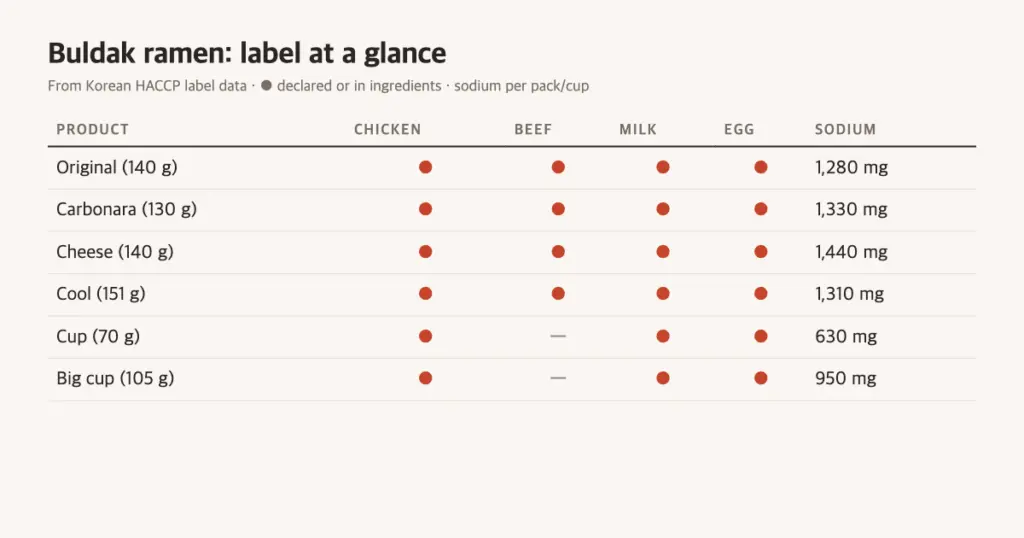
| Product | Size | Calories | Sodium | Allergen line on the label |
|---|---|---|---|---|
| Buldak (original), pack | 140 g | 530 kcal | 1,280 mg (64%) | Wheat, soy, egg, milk, chicken, beef |
| Carbonara Buldak, pack | 130 g | 550 kcal | 1,330 mg (67%) | Wheat, soy, egg, milk, chicken, beef |
| Cheese Buldak, pack | 140 g | 550 kcal | 1,440 mg (72%) | Wheat, soy, egg, milk, chicken, beef |
| Cool Buldak, pack | 151 g | 600 kcal | 1,310 mg (66%) | Soy, wheat, egg, milk, chicken, beef |
| Buldak cup | 70 g | 280 kcal | 630 mg | Wheat, soy, egg (yolk), milk |
| Buldak big cup | 105 g | 425 kcal | 950 mg (48%) | Not filled in the data |
Percentages are the share of Korea’s daily reference value for sodium, as printed on each pack. Also, the two cups list fewer allergens in this data, but their ingredient lists still include chicken. So read the next section before you assume a cup is meat-free.
What’s actually in it: chicken, beef and dairy
Every Buldak product here uses chicken-based seasonings. On the Korean labels, that means grilled chicken concentrate, chicken flavor powder and a chicken curry base. The Cheese and Cool packs even state the chicken content of their liquid sauce: 1.29% and 0.82%.
Beef is a little different. It appears in the allergen line of the bag versions, but no separate beef ingredient is named in the list. In Korea, the allergen line has to cover ingredients hidden inside blended seasonings, so treat these packs as containing beef.
- Carbonara Buldak adds whole milk powder, a cream flavor powder, butter seasoning and mozzarella cheese powder.
- Cheese Buldak lists mozzarella cheese at 2.47% of its seasoning, plus a spicy cheese sauce.
- Original, cup and big cup skip the cheese, but the labels still list milk or egg somewhere in the recipe.
Is Buldak vegetarian, vegan or halal?
Based on the Korean labels, none of these six products is vegetarian or vegan. All of them contain chicken-based ingredients, and most declare beef, milk and egg too.
Halal is a separate question. Samyang sells export packs in many countries, and some retailers abroad list Buldak with a halal logo. However, I couldn’t confirm which flavors are certified from an official Samyang or certifier source. The Korean domestic packs above don’t carry that claim, and they declare beef from an unspecified source. In other words, check for a halal certification logo on the pack you’re holding, rather than going by the flavor name.
How spicy is each flavor?
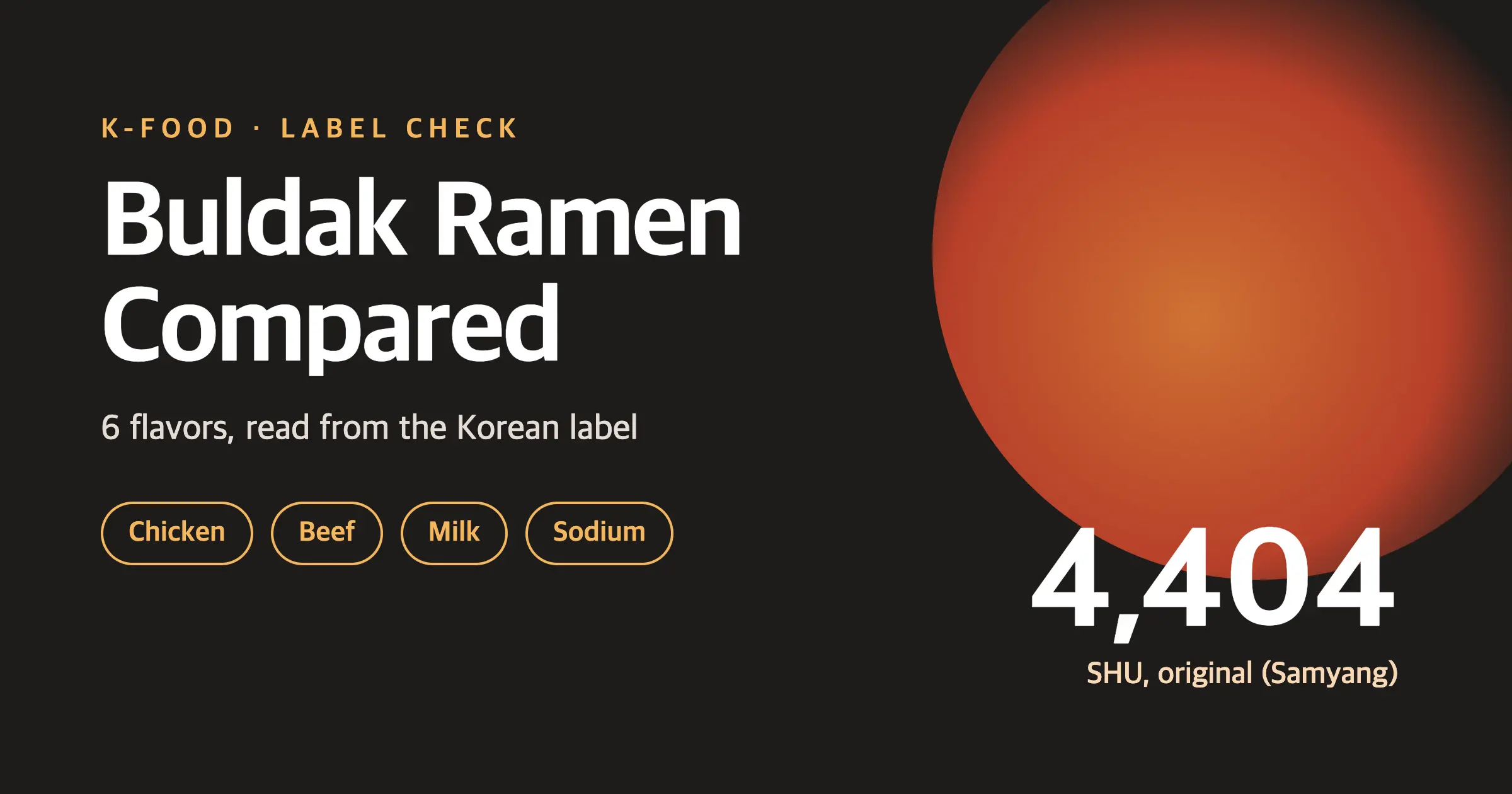
Samyang has published Scoville figures from its own lab for a few flavors. In a 2020 announcement, it put the original Buldak at 4,404 SHU and Carbonara Buldak at 2,400 SHU, roughly half as hot. I couldn’t find official numbers for the Cheese or Cool versions, so I won’t guess.
For comparison, the original is nowhere near the hottest Buldak. The limited Nuclear (Haek) Buldak was rated at 8,706 SHU by the company in 2017, about twice the original.
Sodium: the number most people miss
Spice gets the attention, but sodium is the bigger surprise. A single bag of Cheese Buldak lists 1,440 mg, which is 72% of Korea’s daily reference value. The original bag lists 1,280 mg. The 70 g cup is roughly half that, at 630 mg, simply because it’s a smaller portion.
What it costs in Korea
On October 25, 2026, a five-pack of original Buldak was listed for about 6,300 to 6,900 won on major Korean shopping sites (Naver Shopping). That works out to around $4.80 to $5.20 for five bags, or roughly 1,300 won each. Convenience store prices per single pack are usually a bit higher, and prices abroad vary a lot by country.
Quick tips for buying Buldak in Korea
- Check the allergen line in the white box on the back of the pack. Korean labels list allergens like 우유 (milk), 계란 (egg), 닭고기 (chicken) and 쇠고기 (beef).
- If you avoid meat, skip every flavor in this list, cups included.
- If you need halal, look for a certification logo on the pack itself, since Korean domestic packs don’t carry one.
- Flavors rotate. Seasonal versions like Cool Buldak come and go, so the lineup on the shelf may differ.
The short version
Every Buldak flavor here contains chicken-based seasoning, and most Korean packs also declare beef, milk and egg, so none of them are vegetarian or vegan. The original is rated 4,404 SHU and Carbonara 2,400 SHU by Samyang, and one bag carries 1,280 to 1,440 mg of sodium.
Some links on Haamoni may be affiliate links. If you buy through one, I may earn a small commission at no extra cost to you. As an Amazon Associate I earn from qualifying purchases. Menus, prices and hours were correct when I checked and can change, so confirm before you go.
Sources
- HACCP product label data (Korea Agency of HACCP Accreditation and Services, data.go.kr)
- Segye Ilbo, Samyang Cream Carbonara Buldak launch with SHU figures, 2020-09-07
- inews24, Samyang Nuclear Buldak SHU figure, 2017
- Naver Shopping, Buldak five-pack listings (checked 2026-10-25)
- Frankfurter (ECB reference rate), USD/KRW on 2026-10-23